Search This Blog

Thursday, 24 October 2019

When "Time over Task" defines Productivity !


Source: projectmanagersuccess.com
It's easy to get lost in the maze of work (tasks) during our quest to become more productive. Little do we realise that productivity is as much about time as about tasks and merely focusing on finishing as many tasks as possible may not always be the best approach to being productive. When productivity is at stake, then both quality and quantity hold equal importance, and we can't afford to compromise on either. But maintaining the balance between quantity and quality is easier said than done !

It's not easy being productive in a VUCA (Volatile, Uncertain, Complex and Ambiguous) world, where distractions exist in plenty and we need to try really hard to stay focused. Speed is of great essence in everything that we do but at times things may get too overwhelming for us because of the plenty that we need to work on. So, when "unlimited tasks in limited time" becomes the order of the day, then "prioritisation" is our only saviour and the focus shifts from merely accomplishing things to accomplishing the right things.

Here's sharing about a tool/ technique that could stand us in good stead when we need to balance prioritisation and speed/ time. The tool/ technique is known as TIMEBOXING, a simple way to get the best out of our every effort. Let's explore it in detail below


What is Timeboxing ?
Source:lucidchart.com

TIMEBOXING refers to allocation of a fixed length of time to an activity with the purpose of limiting the amount of time spent on each of the identified activity. This technique ensures 2 things
for us

  • appropriate time is spent on each activity based on their importance (the discretion lies with us in terms of how much time we allocate to each of the identified task/ activity). 
  • dedicated attention and maximum focus is put to each of the identified task/ activity
Unlike POMODORO technique, where the length of time allotted to each identified task is fixed to 25 minutes, here, in TIMEBOXING, there is a flexibility provided in terms of allotting any length of time to an activity, based on our judgement.


Why TimeBoxing would work ?

This technique would work for the simple reason that we live in a highly distracting world and with our attention span waning day by day, we need a technique that could deliver us results without demanding our prolonged attention.  


What are the benefits of Timeboxing ?

Source: litemind.com
Among the many benefits of timeboxing, few of the important ones are as mentioned below:
  • Better control over 
    • time
    • task and 
    • prioritisation of tasks
  • Opportunity to reassess the task in terms of complexity and effort and accordingly modify time allotted, if need be
  • Focus our energy and effort on important items and render us more productive
  • Avoid burnout as we only spend a defined time-length on any activity/ task, irrespective of whether the task gets completed wholly or partially
  • Builds concentration as we devote our full attention to a task for that time-duration.
  • Flexibility in defining different time-lengths for different activities/ tasks
  • Helps avoid procrastination as important things get precedence over less important ones 

What are the steps for applying Timeboxing ?
  • Identify the goal to be accomplished and the objectives to be met
  • List down all the tasks/ activities required for accomplishing the goal/ meeting the laid down objective(s)
  • Calculate and set time-length for each of the identified task/ activity
  • Prioritise the tasks, in alignment with the goal/ objective, in terms of sequence/ order, length and breadth pertinent to each activity
  • Evaluate the progress against the goal/ objective 
  • Reassess the time-length if desired results are not obtained 

Few precautions to take 
  • Before applying the timeboxing technique, ensure to establish the goal first 
  • Set short and realistic timeboxes, keeping in mind the average human attention span and the individual attention span too
  • Have in place a dedicated timer. If using a smartphone or any other gadget for use as a timer, ensure the data is off to avoid any distracting prompts or pokes
  • Build in relevant breaks during timeboxing
  • If not required/ needed, avoid the temptation to finish the entire activity/ task in one go 

Remember, timeboxing is the way to go when you want to be in flow !

Saturday, 12 October 2019

When Prioritisation defines Productivity (Part 3) - Warren Buffet 5/ 25 Rule


Warren Buffet's 5/25 Rule

When Prioritisation defines Productivity, it is not always about what we select but also about what we leave/ don't select. We will always have plenty on our list and it will never be easy to focus and direct our energy and effort on the things that matter most. Here's a rule/ strategy by Warren Buffet, one of the most successful investors in the world, about identifying an focusing on the important things in our life. The rule is known as 5/25 Rule. The power and impact of the rule could be gauged from the fact that it comes from one of the most successful person in the world. 
The story behind the rule goes like this - Mike Flint was Buffet's personal airplane pilot for 10 years and one day Buffet decided to help him plan out his career goals and priorities. The exercise involved Mike listing down 25 important goals of his life and then identifying the top 5 important goals to focus all his energy and effort on. The key highlight of the story is when being asked by Buffet about what he would do with the remaining 20 goals, Mike replied that he would work on these 20 goals intermittently while working on his 5 key goals. This is when Buffet corrected Mike by telling him that those 20 goals are the ones that he needs to avoid at all cost until he finishes with the top five. This is how Buffet helped Mike apply the 5/25 Rule for creating dedicated focus on his career goals and priorities. 

Let's look at the steps of applying the 5/ 25 Rule 
  • Identify the area you want to focus on : Choose the area that's creating the most imbalance in your life and that has the maximum impact on your life
  • Make a list of 25 goals in the area : Build a list of 25 goals, whether short-term or long-term. Make it a wish list and include every conceivable goal related to that area of your life.
  • Identify the top 5 priority goals : This is the most crucial step of the process. Out of the 25 identified goals, identify the most important 5 goals that (according to you) has the maximum impact on your life. 
  • Focus on the top 5 identified goals : Focus all your energy and effort on the top 5 identified goals and eliminate the rest 20 goals. Ensure you don't pay any attention to these "avoid at all cost" 20 goals till you have succeeded in the top 5 identified goals.
The 5/25 rule can be applied to any area of our life and the above exercise could even be done, in general, about life, without getting specific about any area of life.

Remember, the items 6 - 25 are also important but the rule suggests that we avoid letting them become distractions for us while we work on the topmost 5 goals.

Related Articles :


So, get focused and go full throttle in achieving your 5 goals !       

Friday, 4 October 2019

Productivity in a matter of (5) Seconds !


Do you remember how many times you let go of life-transforming opportunities because of a want of action ? Those moments when just a single "inside push (motivation)" from you could have changed the things for better and made your doubts, fears and worries disappear ! 

Try and recollect 

  • That resolution of yours to get up early to exercise/ meditate but then letting laziness take over
  • that intent to imbibe a new positive habit in self but not supplementing the intent with action,
  •  that chance/ risk to make life better but preferring to stay in the comfort zone !


The examples are plenty and all they point to is that it's just a matter of "few seconds" that can make all the difference. If utilised well, these "few seconds" could move us from a static state to a state of action and onto the road to high productivity ! 


Here's sharing about 5 Second Rule (5-4-3-2-1) rule by Mel Robbins and this rule is all about how "five seconds" could turn out to be life changing for us if we can push ourself to take action in the right direction. The rule states that we just get a window of 5 seconds to act on our instinct of doing something we want to and if we don't act within these 5 seconds then hesitation kicks in and excuses take over our brain.

The 5-second rule is very simple to apply - Whenever you get an urge/ instinct to do something that you know you should do, then count backwards from 5 to 1, like 5-4-3-2-1, and just do it (take action). 

Mel has provided the following definition for the 5-second rule "If you have an instinct to act on a goal, you must physically move within 5 seconds or your brain will kill it"
  
The 5 elements of the rule are nicely explained by Mel and i touch upon them, briefly, below:  


First: “The moment you have an instinct…” 

The "instinct" is defined as the the urge, pull or "gut feeling" which tell us to go or not to go for something. It's that guiding "inner voice/ wisdom"

Second: “To act on a goal…”

Being aware of our goal(s) ensures that we take actions to achieve them. Tie/ Align the "gut feeling" or "instinct" to a goal of your life to get the necessary motivation/ inspiration for taking action.

Third: “You must push yourself…”

However hard the things may be, but if we need to take control of our life, we need to push ourselves out of our comfort zone. 


Fourth: “To move within 5 seconds…”

When we get the 5-second opportunity, it's important that we take some positive and progressive action in the direction of our goal. If we don't take any action within those 5 seconds, then our brain is gonna take control and kill the thoughts of action. Even a small, tiny action within these 5 seconds will matter a lot.

Fifth: “Or your brain will kill it.”

Hesitation, Confusion, Overthinking on our part sends a signal to the brain that things are not okay. This leads the brain to go into a defensive mode, compelling us to move into an "inaction" mode.

For a detailed explanation on the five elements of 5-second rule, please refer to this wonderful article by Mel herself - https://melrobbins.com/blog/five-elements-5-second-rule/

Science behind 5-second rule 

Prefrontal cortex is the area of the brain that is related to things like decision making, planning, and cognitive functions. The 5-second rule has direct relation with the pre-frontal cortex. When we start applying the 5-second rule (start taking action within those 5 seconds), we start taking control of our life and turn on the pre-frontal cortex too. I am not detailing the science behind the 5-second rule because Mel has detailed it our wonderfully in her article at  https://melrobbins.com/blog/5-second-rule-hack-science-explained/


Recommended Reading - The 5 Second Rule by Mel Robbins

Ted Talk by Mel Robbins


Just 5-4-3-2-1-GO ! and let more productivity flow ! 

Sunday, 29 September 2019

When Prioritisation defines Productivity (Part 2)- Pareto Principle


We are living in times of big paradox, where the thing that's limited with us is the one that's demanded most. Plenty and Limited, seems to be co-existing together. All around us, we are faced with a  problem of plenty, whether about the choices we are expected to make or the information we need. There's just so much that gets bombarded at us, aimed at grabbing a part of our most precious commodity, i.e., "time", by way our attention and focus. 

Amidst this demand-supply conundrum (where supply of time for everything that demands it is restricted), try to answer the following for you and note down the answers (for later reference) : 
  • Which are those goals that will help me achieve success ?
  • Which are those habits that will make me productive ?
  • Which are those relationships that make me feel satisfied ?
  • What are those things that make me happy ?
  • Which are those friends that i can rely on always ?
  • On a typical day, what are those activities that consume my time ?
  • On what times, do i spend my maximum money on ?
The context for the above questions could permeate into professional sphere also. Let's look at few of the other possible scenarios 

If you are a start-up entrepreneur , you may ask yourself 
  • What activities take up my maximum time ?
  • Which expenses/ type of expenses consume the maximum funds from the allotted budget ?
  • Which ideas will contribute most to the objective of the start-up ?   
  • Which market will give the maximum response ?
  • Which funders will support the long-term sustainability of the project/ idea ?
  • .....  
If you work from home, you may 
  • Which are my most productive hours ?
  • Which activities occupy my non-work hours ?
  • ......
If you are a working professional, you may ask yourself 
  • From among the various tasks that i perform daily/ regularly, which ones map to my job description ?
  • Which of my team members give the maximum output (are most efficient) ?
  • Which customers give me the most business ?
  • ........
(The above exercise could go on for other spheres/ roles of our life but i have restricted myself to these many scenarios only for want of space and time and to move further with the topic)

This list that you created in response to the above activity could turn out to be a "Time Saviour" for you, provided you know how to "prioritise" the items in the list. And why is Prioritisation so important ?  - For the simple reason, that we only have limited/ fixed "time" at our disposal and we better know where/ on what to use it !  

Let me now introduce a simple, effective and popular tool that could help you prioritise and guide us about where to focus our efforts on. From among the myriad activities/ tasks that we do, we could be more productive if we try and focus on the ones that have the maximum impact on us and can give us maximum output for our effort. This is exactly what this wonderful tool/ technique/ principle does for us and this tool is known as "80/20 Rule" or "Pareto Principle". Lets start knowing more about this tool/ technique/ principle


What is Pareto Principle/ 80-20 Rule ?

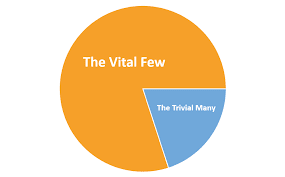
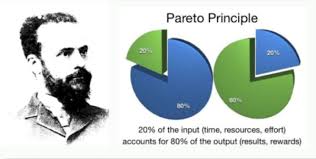
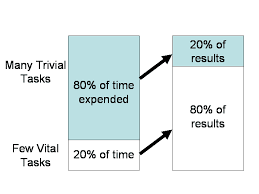
It is a simple time management tool which states that "80 % results come from 20% actions". 

The above connotes
  • majority of the effects in our life comes from minority of the causes
  • biggest results in our lives are generated by few important actions
  • focusing on "Vital Few" rather than "Trivial Many" gives us maximum results
  • maximum results require minimum, but, focused effort

Who invented the Pareto Principle/ 80-20 Rule ?

The invention of this principle/ rule is attributed to the Italian economist Vilfredo Pareto, who was
born in 1848 and observed the 80/20 principle/ rule in 1896. He observed that the presence of uneven distribution when he noticed that 80% of the peas in his garden came from 20% of his pea plants. Another example is when he observed that 80% of the national income of Italy came from 20% population (businessmen/ industralist).

Joseph M Juran, a Management Consultant and also known as "father" of quality conceptualised the Pareto Principle in 1937. 


Why we need Pareto Principle ?

As shared earlier, since time is a limited commodity, we need to spend it wisely, and focus on items that yield maximum output for us. This principle helps us identify the "priority items" that we should focus upon.


Where to apply/ use Pareto Principle ?

The principle/ rule has applications across our personal and professional spheres. Whether it's about our individual productivity or group/ team productivity, Pareto Principle helps immensely in identifying the right priority/ priorities. Some of the industry/ sector/ departments where we see 80-20 rule/ Pareto Principle in Action are Investment, Customer Service, Business Strategy/ Planning, Team Management, Employee Productivity, Revenue Generation, Negotiation, Sales & Marketing, Software Development, Project Management, Social Media Influencing. 

Unconsciously, we seem to use Pareto Principle in our choices or preferences. Consider your personal group of friends, where you always tend to connect with select view when you need some help/ support/ guidance. Same is the case with our professional circle as well. Now, consider your viewing habits where you tend to prefer watching a select few (20%) streaming services like Netflix, Hotstar, Amazon Prime, etc. to make up for 80% of your viewing experience. Consider the case of apps on your smartphone, where again you use just a "vital few" that comprise a majority (80%) of your app usage on smartphone. If you look around, you will see that the market is laden with multiple brands in just about everything but it's only the 20% brand that comprise the 80% sales to consumers. You pick up any aspect of your life, such as Work, Health, Relationship, Wealth, etc.) and you would find Pareto Principle in action there. (Read Related Article: Wheel of Life )

Here's citing my own example of using Pareto Principle while blogging. While conceptualising this post, 20% of the ideas contributed to about 80% of the content/ structure for this post (for that matter, any blog post).  Isn't that amazing ! 


Steps for applying Pareto Principle 

The steps are simple and as listed below:
  • Clearly define the output/ outcome you want/expect 
  • Identify the inputs 
  • Gauge the impact that each input can create on the output 
  • Pick up the top "Vital Few" inputs 
  • Take Action on the "Vital Few"

Recommended Reading : The 80/ 20 Principle by Richard Koch  (click to buy)


Additional about Pareto Principle 

The 80:20 ratio is not sacrosanct and it could be 70:30 or 75:25 or in any other similar proportion. The idea being highlighted here is that "Vital Few" gives us Maximum Output. 

Apart from making use of Pareto Principle / 80-20 Rule in our routine activities, it is useful in understanding and altering our habits and behaviour too. Whether we want to identify priorities, learn something new, work with limited time availability, Pareto Principle/ 80-20 Rule is the one to go to ! 


N.B. - The images used in this post/ article have been sourced from the internet. 

The post also contains some affiliate links and i may earn some commission for my endorsement, testimonial, and/ or link to any product or service from this post  

I am taking my blog to the next level with Blogchatter's #MyFriendAlexa

Saturday, 28 September 2019

When Prioritisation defines Productivity (Part 1)- Eisenhower Matrix


Here's a scenario - "Of  late, Narinder has been feeling quite dissatisfied with himself because he has been very unproductive and as a result feeling very stressed out. Every day he starts with hope and anticipation of achieving a lot (through completing tasks) to make the day count but ends the day completely drained out (mentally and physically), frustrated, feeling incomplete and disappointed with self. The situation has started impacting him adversely and he decides to do something about it. He does a quick run through of his daily routine and gathers this insight that his approach of "dealing with things as they come along" is not giving him the desired results. Though he has been giving his best, in terms to time and effort, to every task during the day but somehow there are things still left undone and the output and results do not commensurate with his effort (let's restrict to the "time" dimension only). Unable to figure it out for himself, Narinder seeks advice from one of his good friends (who has been quite an achiever and a highly productive person) to discuss about what's wrong with his approach. Upon hearing Narinder's saga, his friend asked him just one simple question - "How do you plan your day ?" . Narinder responded by showing him one of his "to-do" lists, to which the friend responded with another question which was "How do you ensure (from this list) that you are putting your energy/ time/ effort on the right thing/ task at the right time ?". Narinder was clueless about the answer and was left wondering about the answer !"

Now, it's time for a reality check - Isn't it the case with so many of us where we fail/ struggle to be productive inspite of identifying the tasks/ activities we need to do in the day ? We try extremely hard to make it happen by way of multitasking, becoming workaholic, and other means but productivity still evades us for the simple reason that "priority is missing in our approach". The moment we get sure of what needs to be done before others is when we will start doing justice to our time and effort.

In this post i am going to cover a very popular tool/ technique on Prioritisation, known as EISENHOWER MATRIX.


Definition & Background

Eisenhower Matrix aka Urgent-Important Matrix aka Time Management Matrix is a very effective model/ tool/ technique that helps us identify the tasks/ activities to focus upon to improve our productivity.

The matrix was the brainchild of Dwight D. Eisenhower, the 34th President of United States from 1953 to 1961. He also served as a General in the U.S. Army. The invention of the Matrix was borne out of his need to help him identify which tasks he should focus on each day.

In my opinion, the Matrix became more popular because of Stephen Covey's bestseller book "The 7 Habits of Highly Effective People". At least, that's where i got introduced to this model/ technique/ tool. In the book it is known as "Time Management Matrix" or "Urgent-Important Matrix". 


Urgent vs Important is the basis of Eisenhower Matrix. The Matrix comprises of 4 quadrants. Each quadrant in the matrix typifies (represents) a position on the Urgent-Important Axis and related to each position an action is assigned. The four actions are Do First, Schedule, Delegate, Don't Do.

Let's look at the Eisenhower Matrix in detail

Source : eisenhower.me

Source : Internet
The Matrix has 4 quadrants drawn against the Urgent and Important axis. The key quadrants to focus upon are quadrants 1 (Important and Urgent, Do First ) and 2 (Important and Not Urgent, Schedule). There are 2 perspectives to this Matrix and they are
  • For Action : Target quadrant 1 when immediate action is to taken on the items/ tasks/ activity
  • For Planning : Target quadrant 2 when organising is of concern. Effectively managing quadrant 2 is the hallmark of a productive person.    

The key objective of the Matrix is to ensure spending maximum time in Quadrant 2. We, usually, start operating the Matrix with the short-term strategy of addressing the Quadrant 1 items so as to avoid reaching a catastrophic state. Remember, always operating in Quadrant 1 is not the objective of the matrix.


Understanding the difference between Urgent and Important

The key to effectively use the Matrix is to understand the difference between Urgent and Important
The URGENT tasks are the ones which have an "immediate" or "now" written against them. They are triggered by external factors and serve only a short-term objective. They are like a "necessary evil" and they need to be addressed at the earliest. For example, a medical emergency or a deadline-driven project. Urgent tasks results in stress and burnout.

The IMPORTANT tasks are the ones which have a direct impact on our life and job. They are long-term in nature. They directly relate to our goals in life and are crucial for our success. For example, Exercising or planning a career change. Important tasks results in balance and control.


Steps for using the Matrix 
  • List down all the tasks that need to be addressed
  • Map these tasks against the various quadrants  
  • Finish off the tasks that need to done on the same day
  • Follow the actions related to each of the quadrant 
    • Quadrant 1 - DO IT
    • Quadrant 2 - PLAN NOW
    • Quadrant 3 - DELEGATE
    • Quadrant 4 - DON'T DO
  • Focus on enlarging the Quadrant 2 for a better control over things and life. An ideal Matrix should look like as shown in the diagram below, where Quadrant 2 is the biggest, which means focus is on items that matter a lot to our goals, jobs in life, followed by Quadrant 1, which is smaller in size (compared to Q2 ) implying less crisis driven tasks, followed by a very small Quadrant 3 and a blank Quadrant 4.


Tips on using Eisenhower Matrix  (sourced from the website eisenhower.me )
  • Transfer "to-do" list on paper/ electronically frees the mind. Here, you may refer to the Brain Dump or Mind Map technique
  • Restrict to writing 8 tasks per quadrant
  • Maintain a consolidated list for both personal and professional tasks
  • Do not let other define your priority
  • Don't procrastinate

Related Articles 

Reference Resources


Eisenhower / Eisenhower Matrix :    https://www.eisenhower.me/

Video Explaining Eisenhower Matrix : https://www.youtube.com/watch?v=suGXZ1869qc

Free Download of Eisenhower Template : https://www.eisenhower.me/eisenhower-matrix-canvas/


N.B. - The images used in this post/ article have been sourced from the internet. 

The post also contains some affiliate links and i may earn some commission for my endorsement, testimonial, and/ or link to any product or service from this post  

I am taking my blog to the next level with Blogchatter's #MyFriendAlexa

Monday, 23 September 2019

POMODORO - The "Tick-Tock" way to Boost Productivity !


Starting each day with the sole intent of being productive and ending the day with a regret of not having accomplished much - 
Isn't that the story for most of us ?

It's true that making the most of our day in this VUCA (Volatile, Uncertain, Complex, Ambiguous) world is not easy at all and we really need to step up our game to make the best of the day.  But inspite of all our effort, at times using strategies like multitasking or technology, we still can't manage to make it happen.

Any guesses, what could be the reason(s) ? Well, plenty of external factors to blame (like people, circumstances, timing, and so on because according to us, we were always giving our best every day through multitasking and doing everything that comes our way !

What if, on some deep reflection, you discover that the onus to make things happen lay only on you ? Just think that inspite of you being bombarded with requests, orders, and distractions of all kinds, wasn't it still within our control to work out things properly, had we focused and concentrated on the right things, in the right way !!!

Yes, you read it right, FOCUS and CONCENTRATION, did us in, and that's why we couldn't manage to extract the best from the day. Just try and recollect your juggling and shuffling acts  from the day (shifting focus among multiple tasks/ activities) that did not let you give sufficient time to any of the task to ensure its' completion. This cycle keeps getting repeated day after day, leaving us to wonder whether this is how things will ever remain or there's some way to change it !

The good news is that there's definitely a way we could change it and that's what i am going to cover in this post. The tool/ technique that can work magic, in this scenario, is known as POMODORO . Let's look at what it is all about


Definition and Background of Pomodoro

Pomodoro Technique is a time management/ productivity tool that promotes working in a focused manner for a time interval of 25 minutes (as professed mostly), followed by a short break of about 3-5 min. (More will be described in sections below)

The Pomodoro Technique was developed by Francesco Cirillo, www.francescocirillo.com,  in the late 1980s ( the first pomodoro in 1987) when Francesco was a student studying in the first year of his college. The Pomodoro Technique was developed out of his need for an effective study method/ technique, as he was passing through a phase of low productivity and high confusion. The term "Pomodoro" is named so because the first timer that the author used was a kitchen timer in the shape of a "tomato".


When to use Pomodoro ?

The Pomodoro is very effective in many situations. For the sake of context, i am mentioning below the four key areas where we struggle most and where Pomodoro technique could help us immensely in addressing the bootlenecks 
  • Procrastination : when we tend to keep postponing important task for some later day 
  • Prioritisation : when we are unable to decide about which tasks/ activities to take up first
  • Productivity : when our efforts do not give proportionate results 
  • Planning : when we constantly set unrealistic timelines

Why to use Pomodoro ?

Few of the key benefits of using Pomodoro are as below :
  • Time 
    • reduce/ remove anxiety
    • manage tasks/ activity better
  • Productivity
    • achieve more with less effort 
    • finish more tasks
  • Establishing right priority
  • Personal Improvement : provides opportunity for
    • self-observation/ self-reflection
    • course correction 

Resources/ Material Needed
Sample of filled in Pomodoro sheets
Source: Internet
  • Timer - electronic or digital
  • Pencil/ Pen
  • Following sheets (printed/ hand drawn)
    • Activity Inventory - This contains the activities as they come up during the day. These are the Unplanned activities. At the end of the day, the activities that have been completed are ticked off.  
    • To Do Today - filled at the start of the day and contains all the tasks/ activities planned for the day, mentioned with priority. This sheet also contains a section called "Unplanned and Urgent" to list all the unexpected tasks (that needs to be addressed) that come up during the day
    • Records - This sheet captures the effort for each task/ activity in terms of the number of Pomodoro. This is update once, usually at the end of the day.

How to implement/ apply Pomodoro ?

Implementing the Pomodoro technique is very simple and consists of the following key steps 
  • Set the timer to 25 minutes for the first Pomodoro 
  • Refer to the "To Do Today" sheet and start with the first activity mentioned
  • Work on the activity till the timer rings
  • Fill the "To Do Today" list by putting a "tick" against the current Pomodoro finished.
  • Take a 3-5 minutes break
  • Start with the next Pomodoro from the list 
  • After 4 Pomodoros, take a 15-30 minutes long break
Now, let's look at an important "IF" scenario
  • If/ When Pomodoro gets Interrupted: It's next to impossible to insulate ourselves from the outside world. There will always be disturbances when we work. While doing Pomodoro, there are 2 kinds of interruptions that may occur and those are :
    • Internal Interruptions - these are self-created/ self-driven distractions imposed by our urges like getting up for water/tea/ snacks, or to call a friend, to look for something, and similar things. To address them, we need to reflect on these to decide whether they are urgent enough to be taken up immediately. If yes, then we need to put an apostrophe (') in the appropriate "To Do Today" sheet and mention them under the "Unplanned and Urgent" section in the "To Do Today" list. In case, they are not urgent, then they get mentioned in the "Activity Inventory" with a U (Unplanned ) alongwith a tentative date mentioned for each of the activity.
    • External Interruptions - these refer to the distractions created by others and may refer to tasks being imposed by others, emails from others, call from  others, and similar ones. When these occur, firstly we need to put a dash (-) against the Pomodoro activity when it happened in the "To Do Today" sheet. Then, based on their level of urgency we address them using the Inform - Negotiate -Call Back" and decide where to place them, whether in the "Unplanned and Urgent" section of "To Do Today" sheet or in the "Activity Inventory" sheet, marked as " U(Unplanned)", just like the way we do with the internal interruptions.    

Where all we can use Pomodoro ?

Pomodoro is a simple yet very powerful technique used both in Individual and Team setup. It can be successfully applied to activities like studying, writing, meeting, presentations, events, planning , projects, and many more.


Always Remember about Pomodoro
  • The Pomodoro is indivisible ( we can't half a half or quarter pomodoro)
  • The plural of Pomodoro is Pomodori ( when we refer to multiple pomodoros, we address them as pomodori)
  • Each Pomodoro is of 25 minutes duration, followed by a 3-5 minutes break
  • After every four Pomodoros, take a 15-30 minutes break
  • If a task takes more than 5-7 Pomodoros, break it down to several activities
  • Never use the break periods to do things related to Pomodoro activity. The idea of break time is "free time", so do activities that will help relax and recharge the brain, maybe having tea/ coffee/ general chat with friend/ colleague/ eat a healthy snack/ read an article quickly, do a quick stretch, etc.
  • Don't use this technique for/ during "free time" / "break time". That time is meant for relaxation. 
  • If a task less than one Pomodoro, add it up (combine with similar simple activities)
  • If a Pomodoro gets interrupted, then it becomes void and we need to start with a new Pomodoro
  • If a Pomodoro begins, it has to ring (for closure). (Ring connotes a sound, beep, timer sound, etc.)
  • If a task finishes early in a Pomodoro, review the work till the Pomodoro rings (till 25 minutes get over)
  • Protect the Pomodoro (in case of external interruption) by using the "Inform Effectively - Negotiate Quickly - Call Back" strategy. 
  • It takes 7-21 days to master the Pomodoro Technique

Trivia about Pomodoro


Here's some trivia about Pomodoro
  • In Italian, Pomodoro means "tomato".
  • The reason behind 25 minutes is based on the research which suggests that anywhere between 20-45 minutes time interval can maximixe a person's attention and mental activity. The 25 minute duration for Pomodoro was arrived at after conducting few experiments with the audience to check for the appropriate duration for a person to be active.  

Resources to Refer

Please note that you may find slight variation in the format of the Sheets used for Pomodoro. I have restricted myself to using the ones originally mentioned by the Francesco Cirillo, the creator of Pomodoro. 

And, just in case you are wondering about the title of this post - the tick refers to the check that we put after completing a Pomodoro and tock refers to the clicking of the timer . Also, i took about 5 pomodori for writing this post :)


Don't wait and go Pomodoring today !

N.B. - The images used in this post/ article have been sourced from the internet. 

The post also contains some affiliate links and i may earn some commission for my endorsement, testimonial, and/ or link to any product or service from this post  

I am taking my blog to the next level with Blogchatter's #MyFriendAlexa

Friday, 20 September 2019

Mind Map - The Magic of Visual Thinking !

Have you ever found yourself short of 
  • being innovative and generating new ideas ?
  • finding creative solutions to things ?
  • managing time effectively ?
  • setting and achieving goals ?
  • maintaining work-life balance ? 
  • planning (effectively)for something extremely important ?
  • remembering and recalling important information (timely)
  • gaining clarity on the relationship between the big picture and the small elements that make that picture
If your answer is "yes" to any of the above, then it's time to ponder over these 2 questions
  • what effect/ impact it could have on me if i leave any of the above task/ activity unaddressed ? 
  • is something amiss with my approach and how could i improve it ? 
Lets try and connect the dots to get a clear picture - thoughts are integral to us (we get plenty of them each day, to the tune of about 50,000 per day) and each of the above mentioned item has an

associated thought (thoughts) residing in our brain. Somehow, the brain is unable to effectively process it and provide better results to us. 

Wouldn't you feel elated, if i share with you about a simple yet powerful tool/ technique that could help us constructively deal with the barrage of thoughts and convert it into outcomes that are more clear, concrete and actionable. This then leads to a life which is in better control and well balanced.

Before i talk about the tool, let me share the two steps that help us move from a cluttered state to a clear state.

1. Shifting the thoughts clogging our brain to an outside storage.

2. Creating/ Making sense of the dumped thoughts (here the "dumped" connotes those that have been copied/ moved out from our brain to an external storage)

The first step we addressed through the Brain Dump technique taken up by me in my previous post  (Related Post : Brain Dump - Declogging A Cluttered Mind )

The second step is where this tool, that i am going to talk about, makes a huge difference. This tool holds the capability to connect the dots, identify and organise related thoughts and then put them together to create sense and meaning. In a nutshell, the tools enables the brain to function more effectively because it presents the brain with all the information in the way the brain prefers. The tool is MIND MAP.  Let's delve deep into the tool

Here's sharing with you, in this post, about a tool that not only organises the information into a more appealing visual form but also ensures that the brain functions most effectively. The tool is quite popular and known as MIND MAP.  The need to share about this tool because of our inability to organise the thoughts properly into an appealing form for the brain. Let's delve deep into the tool


Definition and Background

I will mention few simple ones for sake of building clarity about the tool.

Mind Map is a 
  • visual tool that maps out our thoughts in an organised and structured manner
  • graphic tool/ technique to visually organise and structure information to make it easy for us to comprehend, remember and recall the information.  
  • visual thinking tool that helps structuring information for easy analysis and recall
  • graphical/ visual way to represent ideas, concepts and tasks  
Mind Map was invented by Tony Buzan, a British psychologist, Writer, "Memory" guru (if i can call him so !) and Mental Literacy Specialist . Mind Maps were formally introduced in the year 1974 with the publication of the book "Use Your Head". The Mind Map technique was borne out of the need for a more effective way, based on the principles of Brain, to enable better learning and thinking.

Why Mind Map ?

Mind Map helps in learning, organising and storing information. 

The most important reason for using Mind Map is to effectively utilise our brain by way of 
  • activating our "whole brain"
  • decluttering our brain
  • building focus/ better focus 
  • presenting the "big picture"
  • establishing connection between discrete pieces of information
  • making us more creative
  • rendering us more productive
  • improving our remembering and recall of information
  • and plenty more 

What makes Mind Map effective ?

The key reason Mind Map is effective because it works like the human brain while organising/ structuring information. The Mind Map is based on the concept of Radiant Thinking, an instinctive way of developing and defining ideas in the mind. According to Tony Buzan, the neurons in the brain work on the principles of connection/ association, and that's exactly what gets manifested in Mind Maps. Each neuron has a vast number of dendrites reaching out and establishing association with
other neurons. The possible number of associations is unlimited. Likewise, Each bit of information that enters our brain becomes a central point from which emerge (radiate) millions of associations that further may establish infinite links and connections. 

In case of Mind Map too, the main themes span out as branches from the central image (of the subject/ topic). These branches represent the key themes associated with the main topic(central image). These theme branches further extend to create more associations and this goes on this way.
This is how Mind Maps use the concept of Radiant Thinking.

Essential Characteristics of Mind Map (Sourced from The Mind Map Book - Tony Buzan)
  • The main subject/ topic is displayed through a central image
  • The key themes of the subject/ topic emerge (radiate) from the central image as branches
  • Branches comprise of key image or key word mentioned on the association line
  • Branches form a connected nodal structure

Key Elements of a Mind Map 

Always, remember that brain has a natural aptitude for visual recognition and Mind Map is all about memory and learning, therefore the elements should accelerate the process.
 
The four key elements are 
  • Images (Central Image and other Branch Images)
  • Lines (Curved and different sized lines for emphasis)
  • Words (Single Key words)
  • Colors (to make the map visually appealing)

Drawing/ Making a Mind Map

Material Needed - Just 2 things are required 1. Plain Paper of  min. A4 size (the bigger the paper size, the better the mind map) and 2. Color pencil/ color/ multicolor pen/ highlighter/ anything that can provide color to the mind map  

Steps : 
  • Start at the Center 
  • Draw/ Use an Image or Picture
  • Draw the Main Branches
  • Make the Branches big and curved
  • Use single key word per association line (branch line, sub branch line, and so on..)
  • Use colors throughout wherever possible (maybe to write, draw, highlight, underline, etc.)
  • Keep it free flow because that's what the structure and intent of the Mind Map is

Precautions during drawing the Mind Map
  • Always have one subject/ topic for the Mind Map. We can't have 2 topics in a single mind map
  • Always start from the center to keep it aligned with the concept of Radiant Thinking
  • Use a big plain paper (the bigger, the better) for drawing the Mind Map
  • Initially, when new to Mind Map, limit the number of branches to 5 or 6
  • Ensure each branch has a single Key Word
  • Have only 3 to 4 sub-branch levels
  • Place as many images as possible on the branches of the Mind Map and the Mind Map, per se.

Application of the Mind Map
Mind Maps is useful in almost all areas of our Personal and Professional Sphere. Few examples are
  • Personal goal-setting
  • Life Planning
  • Business Planning
  • Preparing a Lesson Plan
  • Preparing and Delivering Presentations
  • Storytelling
  • Decision-Making
  • Problem Solving
  • Self-Analysis
  • Brainstorming (individual and group)
  • Study Notes
  • and so many more


In case, you prefer an digital version of Mind Map, there are plenty of options available, for both online and downloadable. There are free versions as well as paid versions available. I worked a lot on Freemind when i started Mind Mapping, maybe because the tool was free (in fact an open source tool). You may check the list of some of the softwares at Mind Mapping Softwares.

In case, you do not want to draw your own mind map, then there are plenty of free Mind Map templates available on internet for downloading. Even the mind map softwares also have a repository of templates for use.

In case you would be keen to have a look to few of the wonderful books on the subject then click on the following links : Mind Map and Mind Map Mastery

Before i end this post, here's sharing one of the mind maps that i created for this blog post :) - (still learning the nuances)


So guys, let your creative juices flow and it's time to go Mind Mapping :) 

N.B. - The images used in this post/ article have been sourced from the internet. 

The post also contains some affiliate links and i may earn some commission for my endorsement, testimonial, and/ or link to any product or service from this post  

I am taking my blog to the next level with Blogchatter's #MyFriendAlexa