Search This Blog

Showing posts with label personal development. Show all posts

Wednesday, 9 March 2022

Comfort Zone - A Dream Killer!


Just imagine yourself deciding against  

- upskilling yourself as you get older

- looking for new opportunities when you feel dissatisfied at work

- moving out of a relationship, which doesn't seem to be working out, inspite of your best efforts

- pursuing your hobbies or interests, when there is clearly a need for you to relax and de-stress

Maybe you overlooked the long-term impact the above could have on you. The "present" may seem to matter more for you because it's not putting demands on you to do anything new or different. 

But can you afford to remain oblivious to the need to grow and progress during these dynamic times?

MAYBE NOT !!!   

Because it's anybody's guess about what all we stand to lose if we decide to remain static and inflexible. 

REMEMBER - "You can't learn to swim in still water...You can't move ahead by confining yourself to status quo...You can't progress by staying stationary...You can't grow unless you nurture yourself"

And when living your BEST LIFE is at stake, you can't take chances by being average or mediocre.

The home you may have confined yourself to may seem comfortable for a while and in some cases, a while longer, but the charm soon wanes off. The familiar territory starts to appear so alien and the feelings of ease and comfort gets replaced with fear and uncertainty. 

A comfort zone can feel like home, just like resting on the seaside after an exhilarating swim. If it is only about resting for a while, its absolutely fine BUT when you get too comfortable being comfortable that’s when the real problem begins.

When you become like a ship docked in harbour for too long, you stop exploring the waters.

When in comfort zone, be mindful about not staying there for too long else complacency will creep in and steal away your progress & potential.

So, GEAR UP to

- try something new,
- try some challenging stuff,
- push your limits &
- give the unthinkable a chance!

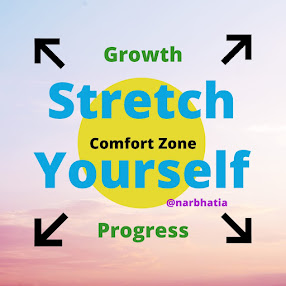
Stretch yourself a little more…Step beyond your comfort zone BECAUSE that is where the MAGIC is 😊!!!

Monday, 16 August 2021

What's your raison d'etre?

Let's start with few simple questions

Are you excited about what you do?

Do you know why you do what you do?

If your answer is NO to any or both of the above, then it's time for self-introspection!

So, what should you do when you realize that your heart is not in the work you are doing and you seem to be just going through the motions?

The easiest thing to do is to start playing the blame game and look for the easy scapegoats, but the question to ask here is - for how long can you keep doing so and where would this lead to, in the long run? Is it going to lead to something better in your life or only lead to more confusion?

The feeling of emptiness that stares at you at the end of every workday and the frustration and irritation you experience in your work is an indication of "motivation" missing from your life and that's exactly what you should be addressing.

This is when you should start to engage in self-probe and discover the "WHY" of your work, the missing "PURPOSE" of your work/ life. What is it that keeps you going? What is it that gets you excited about life? What is it that makes you look forward to the day? 

It's not difficult to sense whether you are living with a purpose. When your head and heart are in sync while doing what you do, then it's an indication that you are living your purpose. When, at the end of the day, you feel you have made a difference with your action/ activities, you can be rest assured that you are living with a purpose.

PURPOSE and PASSION go hand-in-hand. Start by getting your purpose in place and the passion will follow suit. And, when you hit the sweet spot at the intersection of the two, you will be on course to discover your IKIGAI too!

Focus on the value you want to generate and the impact you want to create and you would start on your journey to discovering your purpose. get to understand the difference you want to bring through what you do and therein will lie your purpose.

There's always an impact you are creating with your vocation and all you need to do to realize that is to link your efforts to the big picture!

Summing up concisely, here's what you need to be aware of

Why do you need Purpose in life? As simply as to make your life worthwhile and live with an agenda.

How do you know you are living with Purpose? When you start to feel that you have accomplished something and have made a difference with your work/ vocation.

How do you go about identifying your Purpose? Observing whether what you are doing(actions) is generating the impact that you have identified for your life.

It's time to start living "purposefully"!

Saturday, 4 January 2020

7 Mantras For An Awesome 2020 !


Another year has gone by leaving us with plenty of experiences and memories. Like every year, 2019 also had its share of good and not-so-good moments for us, some cherishable and some forgettable ones. The times we faltered and failed were also opportunities to learn from our mistakes and get wiser. Now, it's time to consolidate on the learnings from 2019 and apply them to make 2020 a better year. 


Here are Seven Simple Mantras to make 2020 an awesome year 
   

CREATE A VISION for your Life - We are strongly driven by the desire of accomplishment and
the more we achieve, the more motivated we get to go after big/ bigger dreams of our life. But the trick to accomplishing and achieving our goals lies in knowing and establishing the big picture first i.e. gaining clarity on what we want to achieve and how our current actions/ tasks will contribute to achieving what we want to. A clarity-induced action is more effective than a random one. For our actions and efforts to make an impact, we need to clear about what they are aimed towards. So, before you set any expectations from the new year, set clear expectation from your life first. Understand and know how you see yourself years ahead from now (maybe 5 years, 10 years, 15 years, and so on) ? how would you like to contribute to the society/ world ? how would you like to be perceived/ remembered ? Using vivid imagery (including all the senses to describe) could help us create a vision compelling enough to inspire us and motivate us to keep going strong for the entire year and beyond. Always remember that a well crafted Vision is the foundation of establishing appropriate goals.  Here's an excellent video to help create vision - https://www.youtube.com/watch?v=nkrW3OgB9K0


ADOPT A POSITIVE OUTLOOK - There will always be times in our life when certain events or episodes would not work in our favour and we will feel as if life is slipping away. The moment we let these "unfavourable results" seize control over us is when we actually lose grip on our life. Life is always a mixed bag and the sooner we accept this reality the better prepared we will be to deal with the troubles and tribulations of life. Why should we fret about things that lie outside our scope of control ? Worrying about such things (events, situations) only distract us and render us unproductive as we tend to skip taking any action at all. Can we, instead, inculcate an outlook of possibility and optimism, so that we remain focused on doing what's in our control - taken progressive action even the chips are down !


ADAPT TO THE UNCERTAINITIES -  How many times does it happen with us that we find ourselves unable to cope with the fast turn of events ? Definitely, that happens quite a lot  because it's not easy to survive and thrive in a world that's dynamic by nature and where we are expected to do things "on the fly", most of the times. To be prepared for every eventuality is just not possible in this VUCA (Volatile, Uncertain, Complex, Ambiguous) world, because most of the factors responsible for triggering any event, are outside our scope of control. However hard we may try to control the outcome, there will always be some additional factor(s) that will further impact/ alter the outcome. So, in a world characterised by the unpredictable nature of things, the best way to prepare ourselves to meet the challenges is to be flexible in our approach and always be prepared to accept the things as they turn out to be, without judging them. The moment we start anticipating and expecting too much is when rigidity creeps in our approach and we tend to mess things up and land up in precarious situation. So, let's always be ready by being flexible !


AFFIRM YOURSELF EVERY MORNING/ DAY - Positivity is a habit and we inculcate it through consistent practice. Every morning, when we set out to start our day, stating our positive intentions emphatically ensures that we make the best of the day. Affirming ourselves regularly and on daily basis helps us do away with doubt and fear in our thoughts and actions, and instills in us the confidence and courage to go ahead and execute our intentions. So, let's be emphatic enough to invite the right energy from the Universe, in our life, to support us in bringing goodness in ourselves and in everything around. So, let's state every positive thought/ resolution as emphatically and consistently as we can to make it become a reality.


CELEBRATE EVERY SMALL WIN - Haven't we all heard/ read the following quotes :
    • "The journey of a thousand miles begins with one step"
    • "Success is a series of small wins"
    • "A little progress each day adds up to big results"
Each of the above quotes holds validity in context of the times we live in, where we always aim high
and big, but tend to ignore or skip taking those small steps that lead us closer to our goals. In the absence of acknowledging the power of these small steps, each and every goal of ours become so overwhelming and a huge task to accomplish. We need to realise that "success cannot be hurried up" and is a process which takes its own sweet time to materialise. Even if we just take small, tiny but progressive and positive steps regularly, we would manage to accomplish all our goals and dreams. The best that these small wins do to us is that they help us build/ maintain the desired momentum to keep moving forward in life and instill in us the key virtues of Patience and Focus, that are so much desired to thrive in this information-overloaded world. Lets perceive "big picture" of our life in terms of small manageable goals, and lose any moment in celebrating and cherishing small successes.     


TAKE RISKS (TO MOVE OUT OF COMFORT ZONE) - Comfort and Convenience is never an indication of growth but that of stagnancy. The more comfortable we get with what we have and where we are, the more we prepare ourselves for a slow but sure death (not literally). To derive the maximum out of our life, we need to keep inventing and re-inventing ourselves and that happens when we keep growing and evolving regularly and continuously. Growth comes from venturing into the unknown and attempting new things. So, letting go of the "fear of unknown" is the starting point for moving out of our comfort zone and when that happens, we live a more fulfilling life because there's so much to experiment, explore and accomplish.  A constant self-reminder that  "a comfort zone is a beautiful place but nothing ever grows there" always keeps us on our toes to keep trying new and different things and make our life adventurous.   


SEEK INNER GUIDANCE/ WISDOM (CONNECT WITHIN) - There are times and moments in life when all our attempts to seek answers from outside fail because for certain problems, the answers lie within only. This is why being our biggest ally helps because this support system is the most reliable one, is always available to us and will never fail us. Falling back on others may not be a feasible option always, so it's better to be our own cheerleader. There's an Inner Guide within each one of us that has all the wisdom that may ever be needed to live an enriching life. At times, when we need hope, courage or clarity, the inner compass ensures that we stay on track. So, the more deep is our inner connection, the more clarity and confidence will be visible in all our actions. Let's put trust in our inner guru and it will never let us down because it knows what we want and what is best for us !


So, look no further than these simple 7 principles and set yourself on course to a rewarding journey in 2020  !  

Wednesday, 11 December 2019

The Productivity Triangle - A Simple Framework For Getting Productivity Right


The road to productivity is not always smooth even when we are equipped with an arsenal of a range of productivity tools. There will  always be instances when productivity tools will fail to do the job for us (boost our productivity) and leave us at crossroads. During this state of confusion, the most important thing we need to do is to curb our tendency to fall prey to self-doubt or engage in dismissing the capability of the tool(s). Rather, this is the moment to brood over whether we are implementing productivity in the right manner i.e. in a holistic way and not in isolation (under the influence of some assumption(s)). The most basic assumption that we fall prey to us is that a framework is not essential for becoming productive and all that we need to do is to fit in the missing pieces (productivity tools)  and "lo and behold", we will be enroute super productivity !

(Related Post : Beating The Productivity Paradox )

Well, life does not operate on assumptions and if becoming productivity was as simple as picking up
a tool and implementing it, then we wouldn't be discussing about productivity being a holistic concept. Randomly handpicking a tool/ a set of tools to address the productivity gaps is not enough and that would never give us adequate and appropriate results. The need for a basic structure/ framework productivity arises due to the fact that our choices (related to productivity) could have far reaching impact on an individual's life and personality. The presence of a basic framework will ensure that "right effort is put on the right thing(s) at the right time".  

Here's a simple and easy-to-use Productivity Framework, called the "Productivity Triangle", to ensure the following:
  • a proper understanding of the key impact elements of productivity 
  • building of a holistic perspective in us,  towards productivity 
  • taking the right approach to address productivity appropriately 

Let's look at the elements and application of the Productivity Triangle/ Framework
  • SELF - This refers to the individual and his/ her existing capability, more of a status-quo check.
  • TASK - This refers to the identified activities that need to be focused upon
  • TIME - This refers to the total time available for finishing the identified tasks 
For getting the Productivity right, it's important to understand how each of the above relates to the process of effective productivity. 

When we talk about SELF, it's essential to do a personal status-quo to understand one's strengths and weaknesses (SWOT Analysis helps in this case) so that effort that gets put in by the individual 
commensurates with his/ her available resources(s). At any point, every individual possess certain competencies, skills and knowledge which make up the existing "resource toolkit" for the individual. A "Know Our Self" activity gives an insight about these available resources and also sets the limit for us in terms of defining our scope of control. Attempting to execute a task that requires skill or knowledge beyond our existing set of capabilities would prove to be quite detrimental for our productivity as it will only lead to an unsuccesssful attempt. Please note, that the concept of "Self" extends to include teams, groups and organisations also, based on the context.

Talking about TASK, a wrongly attempted task would lead to expending our effort and resource but with no conducive result. At times, we may focus on a task that's easier to attempt but may not be the one that should be on priority. So, getting to know more about the TASK helps in picking the appropriate one that will impact our life positively and progressively, thereby improving our productivity. There are times, when we tend to pick up a task (from our to-do list) just because it  seems easier to complete or at other times, pick up a task randomly, without any consideration to its importance in the scheme of things at that point of time. Prioritising tasks leads to better productivitybecause we have a limited reserve of energy and focusing energy on the right tasks will yield better results.

Lastly, i talk about TIME, which is another important element but which happens to be a limited resource. If Productivity is Efficiency, then Time is the deciding factor because a general notion is that the more we accomplish in a defined time duration, the more efficient a.k.a productive we would be. The productivity challenge, in context of time, lies in either incorrectly calculating the required time duration for a task or the inability to give uninterrupted time to the task. Inability to manage time adversely affects productivity. 

Steps to effectively implement the productivity triangle

  • Whenever faced with a productivity challenges, identify the element to be addressed, whether it's Self, Task or Time
  • Once the element is identified, it's time to identify the challenge/ issue pertinent to that element. The challenge could even be related to multiple elements, which then needs to be addressed appropriately
  • If the challenge is related to SELF, take a stock of resources needed to accomplish the task and then about the existing ability of the individual. If it matches, then go ahead with executing the task and if a gap exists, then it makes sense to upgrade that identified competency, skill or knowledge. Doing a SWOT Analysis helps in identifying our strengths and weaknesses
  • If the challenge is related to TASK, then ensure to prioritise the tasks and then work on the top most priority item. Using the tools like Pareto Principle, Eisenhower Matrix, 5/25 Rule helps in setting the right priority.
  • If the challenge is related to TIME, then check whether a correct estimation of time needed for the task has been done or not. Once estimation is in place, then make use of tools like Pomodoro, Timeboxing to ensure giving undivided attention to the task that needs to be completed.   
Let right productivity approach take precedence over productivity tools !

N.B. : The images used in this post are sourced from internet

Sunday, 29 September 2019

When Prioritisation defines Productivity (Part 2)- Pareto Principle


We are living in times of big paradox, where the thing that's limited with us is the one that's demanded most. Plenty and Limited, seems to be co-existing together. All around us, we are faced with a  problem of plenty, whether about the choices we are expected to make or the information we need. There's just so much that gets bombarded at us, aimed at grabbing a part of our most precious commodity, i.e., "time", by way our attention and focus. 

Amidst this demand-supply conundrum (where supply of time for everything that demands it is restricted), try to answer the following for you and note down the answers (for later reference) : 
  • Which are those goals that will help me achieve success ?
  • Which are those habits that will make me productive ?
  • Which are those relationships that make me feel satisfied ?
  • What are those things that make me happy ?
  • Which are those friends that i can rely on always ?
  • On a typical day, what are those activities that consume my time ?
  • On what times, do i spend my maximum money on ?
The context for the above questions could permeate into professional sphere also. Let's look at few of the other possible scenarios 

If you are a start-up entrepreneur , you may ask yourself 
  • What activities take up my maximum time ?
  • Which expenses/ type of expenses consume the maximum funds from the allotted budget ?
  • Which ideas will contribute most to the objective of the start-up ?   
  • Which market will give the maximum response ?
  • Which funders will support the long-term sustainability of the project/ idea ?
  • .....  
If you work from home, you may 
  • Which are my most productive hours ?
  • Which activities occupy my non-work hours ?
  • ......
If you are a working professional, you may ask yourself 
  • From among the various tasks that i perform daily/ regularly, which ones map to my job description ?
  • Which of my team members give the maximum output (are most efficient) ?
  • Which customers give me the most business ?
  • ........
(The above exercise could go on for other spheres/ roles of our life but i have restricted myself to these many scenarios only for want of space and time and to move further with the topic)

This list that you created in response to the above activity could turn out to be a "Time Saviour" for you, provided you know how to "prioritise" the items in the list. And why is Prioritisation so important ?  - For the simple reason, that we only have limited/ fixed "time" at our disposal and we better know where/ on what to use it !  

Let me now introduce a simple, effective and popular tool that could help you prioritise and guide us about where to focus our efforts on. From among the myriad activities/ tasks that we do, we could be more productive if we try and focus on the ones that have the maximum impact on us and can give us maximum output for our effort. This is exactly what this wonderful tool/ technique/ principle does for us and this tool is known as "80/20 Rule" or "Pareto Principle". Lets start knowing more about this tool/ technique/ principle


What is Pareto Principle/ 80-20 Rule ?

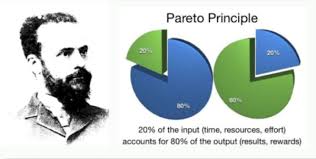
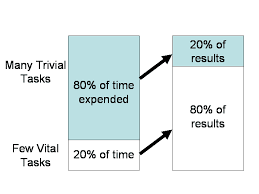
It is a simple time management tool which states that "80 % results come from 20% actions". 

The above connotes
  • majority of the effects in our life comes from minority of the causes
  • biggest results in our lives are generated by few important actions
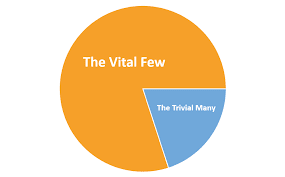
  • focusing on "Vital Few" rather than "Trivial Many" gives us maximum results
  • maximum results require minimum, but, focused effort

Who invented the Pareto Principle/ 80-20 Rule ?

The invention of this principle/ rule is attributed to the Italian economist Vilfredo Pareto, who was
born in 1848 and observed the 80/20 principle/ rule in 1896. He observed that the presence of uneven distribution when he noticed that 80% of the peas in his garden came from 20% of his pea plants. Another example is when he observed that 80% of the national income of Italy came from 20% population (businessmen/ industralist).

Joseph M Juran, a Management Consultant and also known as "father" of quality conceptualised the Pareto Principle in 1937. 


Why we need Pareto Principle ?

As shared earlier, since time is a limited commodity, we need to spend it wisely, and focus on items that yield maximum output for us. This principle helps us identify the "priority items" that we should focus upon.


Where to apply/ use Pareto Principle ?

The principle/ rule has applications across our personal and professional spheres. Whether it's about our individual productivity or group/ team productivity, Pareto Principle helps immensely in identifying the right priority/ priorities. Some of the industry/ sector/ departments where we see 80-20 rule/ Pareto Principle in Action are Investment, Customer Service, Business Strategy/ Planning, Team Management, Employee Productivity, Revenue Generation, Negotiation, Sales & Marketing, Software Development, Project Management, Social Media Influencing. 

Unconsciously, we seem to use Pareto Principle in our choices or preferences. Consider your personal group of friends, where you always tend to connect with select view when you need some help/ support/ guidance. Same is the case with our professional circle as well. Now, consider your viewing habits where you tend to prefer watching a select few (20%) streaming services like Netflix, Hotstar, Amazon Prime, etc. to make up for 80% of your viewing experience. Consider the case of apps on your smartphone, where again you use just a "vital few" that comprise a majority (80%) of your app usage on smartphone. If you look around, you will see that the market is laden with multiple brands in just about everything but it's only the 20% brand that comprise the 80% sales to consumers. You pick up any aspect of your life, such as Work, Health, Relationship, Wealth, etc.) and you would find Pareto Principle in action there. (Read Related Article: Wheel of Life )

Here's citing my own example of using Pareto Principle while blogging. While conceptualising this post, 20% of the ideas contributed to about 80% of the content/ structure for this post (for that matter, any blog post).  Isn't that amazing ! 


Steps for applying Pareto Principle 

The steps are simple and as listed below:
  • Clearly define the output/ outcome you want/expect 
  • Identify the inputs 
  • Gauge the impact that each input can create on the output 
  • Pick up the top "Vital Few" inputs 
  • Take Action on the "Vital Few"

Recommended Reading : The 80/ 20 Principle by Richard Koch  (click to buy)


Additional about Pareto Principle 

The 80:20 ratio is not sacrosanct and it could be 70:30 or 75:25 or in any other similar proportion. The idea being highlighted here is that "Vital Few" gives us Maximum Output. 

Apart from making use of Pareto Principle / 80-20 Rule in our routine activities, it is useful in understanding and altering our habits and behaviour too. Whether we want to identify priorities, learn something new, work with limited time availability, Pareto Principle/ 80-20 Rule is the one to go to ! 


N.B. - The images used in this post/ article have been sourced from the internet. 

The post also contains some affiliate links and i may earn some commission for my endorsement, testimonial, and/ or link to any product or service from this post  

I am taking my blog to the next level with Blogchatter's #MyFriendAlexa

Saturday, 28 September 2019

When Prioritisation defines Productivity (Part 1)- Eisenhower Matrix


Here's a scenario - "Of  late, Narinder has been feeling quite dissatisfied with himself because he has been very unproductive and as a result feeling very stressed out. Every day he starts with hope and anticipation of achieving a lot (through completing tasks) to make the day count but ends the day completely drained out (mentally and physically), frustrated, feeling incomplete and disappointed with self. The situation has started impacting him adversely and he decides to do something about it. He does a quick run through of his daily routine and gathers this insight that his approach of "dealing with things as they come along" is not giving him the desired results. Though he has been giving his best, in terms to time and effort, to every task during the day but somehow there are things still left undone and the output and results do not commensurate with his effort (let's restrict to the "time" dimension only). Unable to figure it out for himself, Narinder seeks advice from one of his good friends (who has been quite an achiever and a highly productive person) to discuss about what's wrong with his approach. Upon hearing Narinder's saga, his friend asked him just one simple question - "How do you plan your day ?" . Narinder responded by showing him one of his "to-do" lists, to which the friend responded with another question which was "How do you ensure (from this list) that you are putting your energy/ time/ effort on the right thing/ task at the right time ?". Narinder was clueless about the answer and was left wondering about the answer !"

Now, it's time for a reality check - Isn't it the case with so many of us where we fail/ struggle to be productive inspite of identifying the tasks/ activities we need to do in the day ? We try extremely hard to make it happen by way of multitasking, becoming workaholic, and other means but productivity still evades us for the simple reason that "priority is missing in our approach". The moment we get sure of what needs to be done before others is when we will start doing justice to our time and effort.

In this post i am going to cover a very popular tool/ technique on Prioritisation, known as EISENHOWER MATRIX.


Definition & Background

Eisenhower Matrix aka Urgent-Important Matrix aka Time Management Matrix is a very effective model/ tool/ technique that helps us identify the tasks/ activities to focus upon to improve our productivity.

The matrix was the brainchild of Dwight D. Eisenhower, the 34th President of United States from 1953 to 1961. He also served as a General in the U.S. Army. The invention of the Matrix was borne out of his need to help him identify which tasks he should focus on each day.

In my opinion, the Matrix became more popular because of Stephen Covey's bestseller book "The 7 Habits of Highly Effective People". At least, that's where i got introduced to this model/ technique/ tool. In the book it is known as "Time Management Matrix" or "Urgent-Important Matrix". 


Urgent vs Important is the basis of Eisenhower Matrix. The Matrix comprises of 4 quadrants. Each quadrant in the matrix typifies (represents) a position on the Urgent-Important Axis and related to each position an action is assigned. The four actions are Do First, Schedule, Delegate, Don't Do.

Let's look at the Eisenhower Matrix in detail

Source : eisenhower.me

Source : Internet
The Matrix has 4 quadrants drawn against the Urgent and Important axis. The key quadrants to focus upon are quadrants 1 (Important and Urgent, Do First ) and 2 (Important and Not Urgent, Schedule). There are 2 perspectives to this Matrix and they are
  • For Action : Target quadrant 1 when immediate action is to taken on the items/ tasks/ activity
  • For Planning : Target quadrant 2 when organising is of concern. Effectively managing quadrant 2 is the hallmark of a productive person.    

The key objective of the Matrix is to ensure spending maximum time in Quadrant 2. We, usually, start operating the Matrix with the short-term strategy of addressing the Quadrant 1 items so as to avoid reaching a catastrophic state. Remember, always operating in Quadrant 1 is not the objective of the matrix.


Understanding the difference between Urgent and Important

The key to effectively use the Matrix is to understand the difference between Urgent and Important
The URGENT tasks are the ones which have an "immediate" or "now" written against them. They are triggered by external factors and serve only a short-term objective. They are like a "necessary evil" and they need to be addressed at the earliest. For example, a medical emergency or a deadline-driven project. Urgent tasks results in stress and burnout.

The IMPORTANT tasks are the ones which have a direct impact on our life and job. They are long-term in nature. They directly relate to our goals in life and are crucial for our success. For example, Exercising or planning a career change. Important tasks results in balance and control.


Steps for using the Matrix 
  • List down all the tasks that need to be addressed
  • Map these tasks against the various quadrants  
  • Finish off the tasks that need to done on the same day
  • Follow the actions related to each of the quadrant 
    • Quadrant 1 - DO IT
    • Quadrant 2 - PLAN NOW
    • Quadrant 3 - DELEGATE
    • Quadrant 4 - DON'T DO
  • Focus on enlarging the Quadrant 2 for a better control over things and life. An ideal Matrix should look like as shown in the diagram below, where Quadrant 2 is the biggest, which means focus is on items that matter a lot to our goals, jobs in life, followed by Quadrant 1, which is smaller in size (compared to Q2 ) implying less crisis driven tasks, followed by a very small Quadrant 3 and a blank Quadrant 4.


Tips on using Eisenhower Matrix  (sourced from the website eisenhower.me )
  • Transfer "to-do" list on paper/ electronically frees the mind. Here, you may refer to the Brain Dump or Mind Map technique
  • Restrict to writing 8 tasks per quadrant
  • Maintain a consolidated list for both personal and professional tasks
  • Do not let other define your priority
  • Don't procrastinate

Related Articles 

Reference Resources


Eisenhower / Eisenhower Matrix :    https://www.eisenhower.me/

Video Explaining Eisenhower Matrix : https://www.youtube.com/watch?v=suGXZ1869qc

Free Download of Eisenhower Template : https://www.eisenhower.me/eisenhower-matrix-canvas/


N.B. - The images used in this post/ article have been sourced from the internet. 

The post also contains some affiliate links and i may earn some commission for my endorsement, testimonial, and/ or link to any product or service from this post  

I am taking my blog to the next level with Blogchatter's #MyFriendAlexa