We are living in times of big paradox, where the thing that's limited with us is the one that's demanded most. Plenty and Limited, seems to be co-existing together. All around us, we are faced with a problem of plenty, whether about the choices we are expected to make or the information we need. There's just so much that gets bombarded at us, aimed at grabbing a part of our most precious commodity, i.e., "time", by way our attention and focus.
Amidst this demand-supply conundrum (where supply of time for everything that demands it is restricted), try to answer the following for you and note down the answers (for later reference) :
- Which are those goals that will help me achieve success ?
- Which are those habits that will make me productive ?
- Which are those relationships that make me feel satisfied ?
- What are those things that make me happy ?
- Which are those friends that i can rely on always ?
- On a typical day, what are those activities that consume my time ?
- On what times, do i spend my maximum money on ?
The context for the above questions could permeate into professional sphere also. Let's look at few of the other possible scenarios
If you are a start-up entrepreneur , you may ask yourself
- What activities take up my maximum time ?
- Which expenses/ type of expenses consume the maximum funds from the allotted budget ?
- Which ideas will contribute most to the objective of the start-up ?
- Which market will give the maximum response ?
- Which funders will support the long-term sustainability of the project/ idea ?
- .....
If you work from home, you may
- Which are my most productive hours ?
- Which activities occupy my non-work hours ?
- ......
If you are a working professional, you may ask yourself
- From among the various tasks that i perform daily/ regularly, which ones map to my job description ?
- Which of my team members give the maximum output (are most efficient) ?
- Which customers give me the most business ?
- ........
(The above exercise could go on for other spheres/ roles of our life but i have restricted myself to these many scenarios only for want of space and time and to move further with the topic)
This list that you created in response to the above activity could turn out to be a "Time Saviour" for you, provided you know how to "prioritise" the items in the list. And why is Prioritisation so important ? - For the simple reason, that we only have limited/ fixed "time" at our disposal and we better know where/ on what to use it !
Let me now introduce a simple, effective and popular tool that could help you prioritise and guide us about where to focus our efforts on. From among the myriad activities/ tasks that we do, we could be more productive if we try and focus on the ones that have the maximum impact on us and can give us maximum output for our effort. This is exactly what this wonderful tool/ technique/ principle does for us and this tool is known as "80/20 Rule" or "Pareto Principle". Lets start knowing more about this tool/ technique/ principle
What is Pareto Principle/ 80-20 Rule ?
It is a simple time management tool which states that "80 % results come from 20% actions".
The above connotes
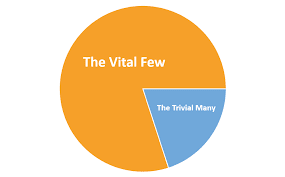
- majority of the effects in our life comes from minority of the causes
- biggest results in our lives are generated by few important actions
- focusing on "Vital Few" rather than "Trivial Many" gives us maximum results
- maximum results require minimum, but, focused effort
Who invented the Pareto Principle/ 80-20 Rule ?
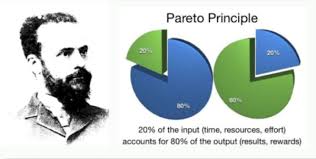
The invention of this principle/ rule is attributed to the Italian economist
Vilfredo Pareto, who was
born in 1848 and observed the 80/20 principle/ rule in 1896. He observed that the presence of uneven distribution when he noticed that 80% of the peas in his garden came from 20% of his pea plants. Another example is when he observed that 80% of the national income of Italy came from 20% population (businessmen/ industralist).
Joseph M Juran, a Management Consultant and also known as "father" of quality conceptualised the Pareto Principle in 1937.
Why we need Pareto Principle ?
As shared earlier, since time is a limited commodity, we need to spend it wisely, and focus on items that yield maximum output for us. This principle helps us identify the "priority items" that we should focus upon.
Where to apply/ use Pareto Principle ?
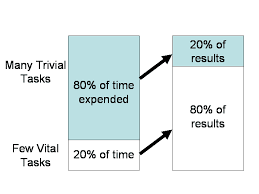
The principle/ rule has applications across our personal and professional spheres. Whether it's about our individual productivity or group/ team productivity, Pareto Principle helps immensely in identifying the right priority/ priorities. Some of the industry/ sector/ departments where we see 80-20 rule/ Pareto Principle in Action are Investment, Customer Service, Business Strategy/ Planning, Team Management, Employee Productivity, Revenue Generation, Negotiation, Sales & Marketing, Software Development, Project Management, Social Media Influencing.
Unconsciously, we seem to use Pareto Principle in our choices or preferences. Consider your personal group of friends, where you always tend to connect with select view when you need some help/ support/ guidance. Same is the case with our professional circle as well. Now, consider your viewing habits where you tend to prefer watching a select few (20%) streaming services like Netflix, Hotstar, Amazon Prime, etc. to make up for 80% of your viewing experience. Consider the case of apps on your smartphone, where again you use just a "vital few" that comprise a majority (80%) of your app usage on smartphone. If you look around, you will see that the market is laden with multiple brands in just about everything but it's only the 20% brand that comprise the 80% sales to consumers. You pick up any aspect of your life, such as Work, Health, Relationship, Wealth, etc.) and you would find Pareto Principle in action there. (
Read Related Article:
Wheel of Life )
Here's citing my own example of using Pareto Principle while blogging. While conceptualising this post, 20% of the ideas contributed to about 80% of the content/ structure for this post (for that matter, any blog post). Isn't that amazing !
Steps for applying Pareto Principle
The steps are simple and as listed below:
- Clearly define the output/ outcome you want/expect
- Identify the inputs
- Gauge the impact that each input can create on the output
- Pick up the top "Vital Few" inputs
- Take Action on the "Vital Few"
Additional about Pareto Principle
The 80:20 ratio is not sacrosanct and it could be 70:30 or 75:25 or in any other similar proportion. The idea being highlighted here is that "Vital Few" gives us Maximum Output.
Apart from making use of Pareto Principle / 80-20 Rule in our routine activities, it is useful in understanding and altering our habits and behaviour too. Whether we want to identify priorities, learn something new, work with limited time availability, Pareto Principle/ 80-20 Rule is the one to go to !
N.B. - The images used in this post/ article have been sourced from the internet.
The post also contains some affiliate links and i may earn some commission for my endorsement, testimonial, and/ or link to any product or service from this post
I am taking my blog to the next level with Blogchatter's #MyFriendAlexa


