Search This Blog

Showing posts with label productivity. Show all posts

Wednesday, 20 October 2021

How to Start Being Productive?


Mark Twain once said "The secret to getting ahead is getting started" and it holds as true for Productivity as for anything else. Most of us compromise on remaining unproductive for our inability to start in the right manner. 

If achieving productivity was that easy, then I wouldn't have felt the need to write this post/ article and you also would not have felt the need to read it. Productivity is not an impromptu or ad-hoc act of action but a process of deliberate intention and action.

If starting to get productive is a challenge, then staying productive is a bigger challenge. But one thing that can make it happen for us is to "PREPARE to be PRODUCTIVE" and it can't get any simpler than this to start (and sustain) our productivity journey. 

Better Productivity comes with Better Preparation and Planning. The cues are always present to help us find whether we are on the right track or not. Here are three simple tips that will surely help us in starting productivity in the right manner.

1. Getting more mindful and observant about our routine. The more aware and attentive we are, the more productive we would get. Knowing what we are doing and why we are doing it is the cornerstone of productivity. Tracking how we tend to spend our day gives plenty of insights into what may be going wrong with our productivity. 

2. Paying attention to the environmental triggers. Knowing what pushes us away or pulls us towards productivity helps us manage our approach better. There are plenty of small and big things that may impact our productivity and knowing what triggers them always helps us become more cautious and conscious of our actions.  

3. Noticing our habits. The patterns we follow or exhibit say a lot about whether we are being rational or biased in our approach. Many times, our productivity takes a hit because we tend to operate out of our comfort zone and stop to look beyond the obvious. If it's time to change our habits for becoming better at productivity, then any further delay only leads to worsening the situation. 

In the end, it's all boils down to finding out what's ailing your productivity and what's aiding it.

So, if you find yourself stuck, it's time to ask yourself -  "What's stopping me from PREPARING (to be PRODUCTIVE)?

Friday, 31 January 2020

Thumb Rules of Productivity


I sometimes wonder why is PRODUCTIVITY still an enigma even when there's so much available on the subject in terms of research, tools and techniques ?

Maybe this post would provide both, a better insight on the above and a solution !


In many of my previous posts, I have covered a whole plethora of tools and techniques on Productivity (See Related Article: ) but still many clients reach out to me, totally confused about how to move ahead with these tools. I don't blame them because just about anyone is bound to feel overwhelmed confronting the wide range of tools and all that these clients need is a simple and easy way to get started somehow, somewhere but in a structured manner. My single piece of advice/ suggestion to them is to identify few "thumb rules" and get started. These "thumb rules" act as simple reminders to ensure that we are on the right path that lead towards productivity. Gone are the days when the only thumb rule for  WORK used to be "As much output as the input". This thumb rule doesn't hold good anymore in these times when we , on daily basis, face the challenge of maintaining focus on things that matter most to us. There's a need to look for "Thumb Rules" that are aligned to the changing times i.e. the VUCA (Volatile, Uncertain, Complex, Ambiguous) world. I share below few such "Thumb Rules" of Productivity that will make it easy for anyone to become judicious about investing effort and focus on the right things in life so that life remains under as much control as possible. 


First Things First 

The most important thing about life is that it is holistic in nature, which means its a cumulation of multiple aspects like Personal, Spiritual, Work, Family, etc. When our life goes out of balance, it's only by putting our focus on the right aspect/ area that we can bring it back to balance. If Family is out of balance, focusing on Work would not compensate for that. Unless we put our effort on the right element, we would not get the desired result and a certain hollowness or a sense of incompleteness will still exist in our lives inspite of putting our best effort. So, we need to look for that clue or indication suggesting what is causing the turmoil, chaos or confusion in our lives and then put it on top of our priority list. We need to always keep in mind that Productivity happens only when our Life is in balance. The WHEEL OF LIFE is a wonderful tool to identify which area/ aspect of our life needs immediate attention and once we know that then it's just a matter of choosing the right actions. 


Let me share a wonderful quote by Henry David Thoreau which will put things in the right context here. The quote is as below :

"It is not enough to be industrious; so are the ants. What are you industrious about ?"

Let's decide where we plan to invest our effort but also be cautious about identifying that "where" !

So, whenever we feel lost about the BIG picture in life, let First Things First be our guide in getting the BIG picture right.


Most Important Thing 


Talking about the situation when we are presented with the task of selecting from similar tasks, how do we do it ? This may not be easy because when all the identified tasks are similar in nature and have more or less similar impact, the confusion is bound to get louder. The best way to deal with such a scenario is to resort to the concept of "Keystone".  The Most Important Thing would be the one which triggers the other positive impacts too. (Related Article : Habits Build Happy Life ). When confronted with the choice of making impactful change in pour lives, we tend to pick up the a habit which triggers other good habits, likewise, from among the available important tasks/ things, we should opt for the one which triggers the rest. An example could be when we set ourselves the task of say Living Healthy. There are so many of us who set this as a resolution almost every year because we never get going on that due to our inability to identify the "Most Important Thing" from the options available. Few options available to us for the same could be - Joining a Gym, Start Exercising, Adopt Healthy Diet, Do Yoga, Wake Up Early. A good look at the options would reveal that it's not difficult to pick up the "Most Important Thing", which in my case would be "Wake Up Early".  I see waking up early taking more of most of the other identified tasks. Likewise, in a work situation, picking up the "most important thing" is about selecting the task that will play catalyst or that will trigger a sort of domino effect.  


Big Thing 


Many a times, even when we have identified the "Keystone" task, we still hesitate to go ahead with it just because its time consuming or slightly complex. We need to remember that avoiding this "Big Thing" , which we know is the most crucial one for us, will keep disturbing us and adversely impact our productivity. However hard we we try to make up for avoiding this "Big Thing" by way of selecting much simpler and less time consuming tasks, we would not be able to avoid the  loss that we may accrue because of this avoidance. Citing the an interesting concept to drive home the point - In the West, nothing is much worse than eating a frog in the breakfast (as first thing in the morning) and if we do that everything else we eat during the day tastes much better. Drawing  a parallel of this concept to our lives, we can say that doing the most difficult task (but the most essential one) first paves the way for us to be more productive because achieving smaller wins becomes much easier. Doing "Big Thing" first in no way connotes finishing it first, it just connotes starting it first and in time. A complex and a time consuming task may spread over multiple hours/ days and all we need to do then is to start it in time and work out some strategy to finish it in time. There are plenty of strategies that could help us achieve that and few ones could be read at - Beating The Productivity Paradox  


One Thing at a Time


We live with the "Busyness" paradox (Related Article: Busyness - The Utopian Paradox ) where pretence seems to rule over actual action and an outcome of the same is the myth of multi-tasking where engaging ourselves in multiple tasks is perceived to be more productive. A little self check would reveal that multi-tasking is lot more time consuming and less effective than mono-tasking because it consumes far more effort and resource in shuffling among the tasks, getting to refocus ourselves and to refresh our memory about the task. Research has also shown that at any given point of time , we have the ability to address/ deal with a single thought only. So, rather that getting enticed/ lured by the prospect of multi-tasking for better productivity, sticking to one task at a time would yield best results and this in no way suggest to leave aside the other important tasks. Through proper priortising and scheduling (Related Article: Beating The Productivity Paradox ), we can manage to be more effective and productive by addressing One Thing at a time.  


Suggested Reading
  • First Things First by Stephen Covey
  • Eat That Frog by Brian Tracy  
  • The One Thing by Gary Keller

Let's get our "Thumb Rules" in place and hop on the bandwagon of Productivity !

N.B. : The images used in this post has been sourced from the internet

Wednesday, 25 December 2019

Demystifying Effective Goal-Setting


Ever wondered about the secret to effective goal-setting ?

However simple and easy goal-setting may sound but there's so much more to it than what appears to
be at the outset. Goal-setting is an important process that defines the future course of our life, and therefore should be catered to with full attention and focus. The most basic purpose of goal-setting is to ensure our progress in life and pave the way for us to achieve and accomplish. Agreed, "action" is what helps us achieve and accomplish, but this "action" is a wasted effort if applied on wrongly prioritised/ identified things or tasks. Therefore, it becomes imperative for our success that we set right/ appropriate goals.

Isn't it the case that in full excitement, so many of us set numerous goals during  the onset of new year but only to find ourselves lose steam while pursuing them, during the course of the year, and ultimately ending in agony at having missed accomplishing the goals we set out to achieve ?

To  whatever extent, we may blame other factors for our failure in accomplishing our goals, the fact remains that the simple act of building "clarity" about things could have addressed this issue for us. 

So, the secret to effective goal-setting is CLARITY and this clarity is about the WHAT, WHY and HOW of Goals. Let's look at each of the 3 steps/ elements in detail


WHAT goal/ goals should be established ?

This is the first and foremost thing to to addressed and getting it right will set the tone for the rest of the 2 steps. How would it feel to see our effort and energy go waste just because we spent it on the "wrong" thing ?  It is definitely not a great feeling and plays heavily on our mind and body because a good amount of our emotion, energy and time got consumed on something that did not yield any returns for us. So, is there a way to identify and establish goals that ensure progression for us ? Surely, there is a way and it is quite simple. A quick recall of our passion and purpose could set the ball  rolling for us in terms of  identifying the appropriate goals. Each one of us are passionate about something and live with a bigger purpose in life, something that gets ingrained in us and become a part of our DNA (not literally). For living that big purpose in life require us to identify some practical milestones and these milestones get referred to as goals. So, whenever in doubt about identifying and establishing appropriate goals, think about what milestones would help you live the purpose of your life. Believe me, this could help us come up with plenty of relevant goals and then it's our discretion to pick the ones that matter most in the given context. For example, if my purpose in life is to be an enabler and empowerer of people, then my identified goals would be around Life Coaching, Training, Counselling and Blogging. Basis my SWOT Analysis, i could identify and establish few goals to focus on.


WHY those (identified) goals should be pursued ?

This is all about finding reasons for pursuing the identified goals. Asking ourself the following few relevant questions could help us be better convinced about the established goals 

  • How do these goals help me live the larger purpose of my life ?
  • What benefits these goals offer to me to help me progress and grow ?
Seeking rationale behind pursuing those identified goals keeps us focused and motivated and the
more direct and specific we get about the returns/ benefits, the better would be our effort for accomplishing these identified goals. For example, if one of my identified goal is to get certification in Life Coaching, then this step is where i start defining the benefits of accomplishing that particular goal. Here, in this example, one of the key benefit might be adding an international credential to my portfolio and opening my offerings to global audience. Anywhere, close to 3 reasons per goal should be convincing enough for us to pursue that goal.


HOW to accomplish the identified goals ?

This step is all about the Action Steps that we need to take for achieving the goals. Getting clear about the steps to take for accomplishing a particular goal makes it easy for us to take action. A goal may just remain a wish in the absence of action and so it becomes very important to identify the actions that will help us in fruition of goals. Anywhere around 5 action steps should be sufficient. Discussing the same example as above, few of the action items for the goal of "getting certified in life coaching" could be to research about the schools/ institutes offering the certification in terms of their validity, duration, fees, content, trainer, etc. Another step in the regard could be to connect with an existing coach to seek their opinion/ suggestion. Here also, SWOT Analysis could help in adopting a more realistic approach to identifying the appropriate action.


Related Articles :

Remember, life is not made merely by setting goals but by achieving them too !

N.B. : The images used in this post are sourced from internet

Wednesday, 11 December 2019

The Productivity Triangle - A Simple Framework For Getting Productivity Right


The road to productivity is not always smooth even when we are equipped with an arsenal of a range of productivity tools. There will  always be instances when productivity tools will fail to do the job for us (boost our productivity) and leave us at crossroads. During this state of confusion, the most important thing we need to do is to curb our tendency to fall prey to self-doubt or engage in dismissing the capability of the tool(s). Rather, this is the moment to brood over whether we are implementing productivity in the right manner i.e. in a holistic way and not in isolation (under the influence of some assumption(s)). The most basic assumption that we fall prey to us is that a framework is not essential for becoming productive and all that we need to do is to fit in the missing pieces (productivity tools)  and "lo and behold", we will be enroute super productivity !

(Related Post : Beating The Productivity Paradox )

Well, life does not operate on assumptions and if becoming productivity was as simple as picking up
a tool and implementing it, then we wouldn't be discussing about productivity being a holistic concept. Randomly handpicking a tool/ a set of tools to address the productivity gaps is not enough and that would never give us adequate and appropriate results. The need for a basic structure/ framework productivity arises due to the fact that our choices (related to productivity) could have far reaching impact on an individual's life and personality. The presence of a basic framework will ensure that "right effort is put on the right thing(s) at the right time".  

Here's a simple and easy-to-use Productivity Framework, called the "Productivity Triangle", to ensure the following:
  • a proper understanding of the key impact elements of productivity 
  • building of a holistic perspective in us,  towards productivity 
  • taking the right approach to address productivity appropriately 

Let's look at the elements and application of the Productivity Triangle/ Framework
  • SELF - This refers to the individual and his/ her existing capability, more of a status-quo check.
  • TASK - This refers to the identified activities that need to be focused upon
  • TIME - This refers to the total time available for finishing the identified tasks 
For getting the Productivity right, it's important to understand how each of the above relates to the process of effective productivity. 

When we talk about SELF, it's essential to do a personal status-quo to understand one's strengths and weaknesses (SWOT Analysis helps in this case) so that effort that gets put in by the individual 
commensurates with his/ her available resources(s). At any point, every individual possess certain competencies, skills and knowledge which make up the existing "resource toolkit" for the individual. A "Know Our Self" activity gives an insight about these available resources and also sets the limit for us in terms of defining our scope of control. Attempting to execute a task that requires skill or knowledge beyond our existing set of capabilities would prove to be quite detrimental for our productivity as it will only lead to an unsuccesssful attempt. Please note, that the concept of "Self" extends to include teams, groups and organisations also, based on the context.

Talking about TASK, a wrongly attempted task would lead to expending our effort and resource but with no conducive result. At times, we may focus on a task that's easier to attempt but may not be the one that should be on priority. So, getting to know more about the TASK helps in picking the appropriate one that will impact our life positively and progressively, thereby improving our productivity. There are times, when we tend to pick up a task (from our to-do list) just because it  seems easier to complete or at other times, pick up a task randomly, without any consideration to its importance in the scheme of things at that point of time. Prioritising tasks leads to better productivitybecause we have a limited reserve of energy and focusing energy on the right tasks will yield better results.

Lastly, i talk about TIME, which is another important element but which happens to be a limited resource. If Productivity is Efficiency, then Time is the deciding factor because a general notion is that the more we accomplish in a defined time duration, the more efficient a.k.a productive we would be. The productivity challenge, in context of time, lies in either incorrectly calculating the required time duration for a task or the inability to give uninterrupted time to the task. Inability to manage time adversely affects productivity. 

Steps to effectively implement the productivity triangle

  • Whenever faced with a productivity challenges, identify the element to be addressed, whether it's Self, Task or Time
  • Once the element is identified, it's time to identify the challenge/ issue pertinent to that element. The challenge could even be related to multiple elements, which then needs to be addressed appropriately
  • If the challenge is related to SELF, take a stock of resources needed to accomplish the task and then about the existing ability of the individual. If it matches, then go ahead with executing the task and if a gap exists, then it makes sense to upgrade that identified competency, skill or knowledge. Doing a SWOT Analysis helps in identifying our strengths and weaknesses
  • If the challenge is related to TASK, then ensure to prioritise the tasks and then work on the top most priority item. Using the tools like Pareto Principle, Eisenhower Matrix, 5/25 Rule helps in setting the right priority.
  • If the challenge is related to TIME, then check whether a correct estimation of time needed for the task has been done or not. Once estimation is in place, then make use of tools like Pomodoro, Timeboxing to ensure giving undivided attention to the task that needs to be completed.   
Let right productivity approach take precedence over productivity tools !

N.B. : The images used in this post are sourced from internet

Wednesday, 4 December 2019

5 Habits of Success

Fact: 
Each one of us has immense potential lying dormant within us.

Why "realising our potential" is important ? - Because only then we can accomplish our dreams and achieve more

How can we "realise our potential" that lies dormant in us (most of the time) ?  - By building discipline and consistency in our actions. In other words, by building right kind of "Habits".

So, it's the right kind of habits that differentiates "mediocre" from "exceptional". Here, in this post, i mention about 5 habits that can help us create our BEST and catapult us to new levels of success and happiness. So, here i go sharing about those 5 key habits


Habit Number 1: Wake up Early 

This is perhaps the most talked about habit of recent times. There are plenty of books and articles available on the subject of getting up early to utilise the "golden hours" and these books and articles  explain in detail/depth about the numerous benefits of getting up early. I would reiterate the need by mentioning the following two quotes
"Wake up early every day so that while others are still dreaming, you can make your dreams come true" - Hal Elrod

"Lose an hour in the morning and you will be all day hunting for it" - Richard Whately

Talking about people who are productive and successful, they tend to always accomplish more than the rest. Ever wondered, how they are able to do that when each one of us have the same 24 hours at our disposal. The answer is simple - they realise the importance of the "golden hours" that exists in the morning, when the distractions are none/few, energy is at its peak, focus is high and then go about utilising those precious hours on doing something productive that can make a huge positive difference to our lives. So, imbibing the habit of waking up early gives us extra hour(s) that can turnaround our lives for better and help us accomplish more. 

Important Benefit From This Habit : A positive, progressive and optimistic start to the day   

Tips to get started :

  • Initially, we should avoid being overambitious in setting the "wake-up" time. Set reasonable and realistic goals, which could be like getting up half-an-hour earlier than the current time and then gradually increase it.
  • Don't hesitate to use a tool/ gadget / strategy to help you build this habit. It could be an alarm clock coupled with the 5-second rule (Read Related Article : Productivity in a matter of (5) seconds )
  • Build in a positive motivation to feel excited about getting up early
  • Work out an agenda for how you would utilise the "early hours". A simple strategy for this could be to utilise the early hours to work on the most important area(s) of your life. You may use the Wheel of Life for the purpose (Read Related Article:  Wheel of Life )      


Habit Number 2: Plan, Prepare and build Priority 
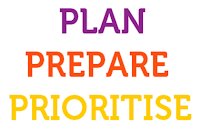
We may let go of the advantage of "golden hours" if we don't build a structure for our day/ life. When we work, there are two types of  FLOW we may engage in - one is where we could just spend our hours, days, months, years and ultimately our life in just going along with the "flow" of things around us, which, in the end, still leave us with feelings on incomplete and unaccomplished whereas the second type of FLOW is when we immerse ourselves in the task at hand because of the passion we have for the work/ task. This type of flow is all about harmony then and this creates balance in our life. Our quest in life is always about the second type of FLOW, where we get completely immersed in the task. So, once we have the right goal(s) identified for ourself, then it's only about the right structure/ framework to ensure that we are in right kind of "flow". This structure comprises of 3 Ps which are Plan, Prepare and Priority and these help us to identify (More and in-depth about the 3 Ps to be covered in a different post)
  • what needs to be worked on i.e. the tasks/ activities/ goals aligned with purpose of life (Plan)
  • resources required for the identified tasks and these resources could be skills, knowledge, expertise, and related (Prepare). A SWOT Analysis could be very helpful in this. (Read Related Article : SWOT Matrix - Know Yourself First )
  • sequence to approach the tasks which refer to identifying the ones which are most important and will have the maximum impact on our life in that period of time 
Few quotes that highlight the importance of 3 Ps  are mentioned below:

"Failing to plan is planning to Fail" - Alan Lakein

"It's not the will to win that matters - everyone has that. It's the will to prepare to win that matters" - Paul "Bear" Bryant

"Good things happen when you set your priorities straight" - Scott Caan
Important Benefit From This Habit : Better productivity by focusing on the "right" tasks 

Tips to get started
  • Identify the list of all tasks to be worked upon. You may use the Brain Dump rule (Read Related Article: Brain Dump - Declogging a Cluttered Mind)
  • Put the list in a visual form (written on paper or digital note pad)
  • Capture the status quo to understand the current capabilities or identify the available resources (Read Related Article: SWOT Matrix - Know Yourself First )
  • Identify tasks that need to be focused on earlier than the rest
    
Habit Number 3: Read/ Read More  

Again, there are plenty of books and articles on the benefits of reading (you may also refer to my post Why Read Books ? ). So, all that i would highlight here is the fact that reading opens up our mental faculties and renders us more creative and comprehensive in our approach towards life. There's a wholeness aspect that reading brings to our personality by way of building up connected knowledge and multiple perspectives about things, people, circumstances and situations. All this helps us deal with the uncertainties and unpredictability of life in a more wiser and rational way, which otherwise, we may never be able to learn experientially in real life, and if we somehow manage to learn, might take many years of our life. So, Reading is the way to go if we want flexibility, freedom and comprehensiveness to become integral to our way (attitude) of approaching life.
on the benefits of reading -

"To acquire the habit of reading is to construct for yourself a refuge from almost all the miseries of life" - W. Somerset Maugham

"Today a Reader, Tomorrow a Leader" - Margaret Fuller

"The man who doesn't read good books has no advantage over the man who can't read" - Mark Twain

Important Benefit From This Habit : A well-read person has a well-rounded personality and better equipped to deal with difficult situations.    

Tip to get started: 
  • Start with anything short and easy-to-read types from your favorite genre
  • After an easy start, move on to reading deeper books from the favourite genre
  • Explore different genres
  • Engage in reading multiple books (from different genre) simultaneously to build connected knowledge 

Habit Number 4 : Connect (More) 

We live in an interconnected or rather a hyperconnected world where individual success is an outcome of mutual success. Just like the internet, considered to be an information superhighway, where utilising the power of hyperlinking, we hop from one piece of information/ knowledge to another and ultimately manage to fulfill our quest, likewise is the case with us in real life too. The social media and the virtual world has indeed bridged the gap among people and anyone could connect with anybody else in just a matter of few clicks. A testimony to this is the reducing "degrees of separation (a measure of social distance between people)", which is now even far below the normal six degree needed for any person to establish connection with anyone else in the world (irrespective of the geographical boundaries). We really need to ask ourselves, whether we are harnessing the power of connections. Remember, the more we connect, the more we open opportunities and avenues to collaborate. In this world of super-specialisation, multiple brains are needed to accomplish things. Here, "quality rules quantity", which means more connections may not always result in more success. It's always about the "quality of connections". So, take time out not just to connect but also to communicate with whom you already are connected. It's time to take that leap from Connection to Collaboration. Here's a wonderful quote highlighting the importance of Connection   

"In a world of algorithms, hashtags and followers, know the true importance of human connection" - Unknown

Important Benefit From This Habit: Develops a "likeability" factor and a "doer" attitude because of the rapport with others    

Tips to get started:
  • Identify and establish your need for "Connecting" and "Collaborating" 
  • Be present and visible on relevant social media platforms
  • Start conversation with relevant "connections" to build synergy
  • Every now and then filter your list of connections (Remember - "Quality" matters over "Quantity")

Habit Number 5: Listen 

In a world that's hungry for attention, whether online or offline (real-life), falling prey to "always be visible" trap is very common and easy. There's a rat race on social media about the "likes" and "views" and this has given birth to the "Talk More, Listen Less" syndrome. Somehow, the virtual world/ social media has misled us in believing that the more we talk, the more we will gain and this has only made the matters worse because now everyone seems to be in a hurry to only talk and share on social media. This attitude has permeated in our real world too and resulted in us losing grip on communicating effectively. We need to remember that listening is the most effective form of communication because it helps in achieving the "win-win" situation far better than any other means. Today, Listening is the most desired skill because we live in a world that's getting devoid of emotions/ empathy. The more we are connecting (virtually), the less connected (real world) we are becoming. The power of Listening could be gauged from the fact that it helps us across a range of areas where "communication" holds the key success. Few examples are establishing better relationships whether in personal or professional life, conflict resolution among team members, business partners or between spouses, conducting agenda-driven and result-seeking meetings, building trust among people, displaying empathy when it matters most, facilitating a counselling, therapy or coaching session, or simply when you happen to be a panelist or a speaker during a forum. So, living in a world where communication and collaboration have by-passed boundaries (physical, cultural, generational, etc.) and made working together quite challenging, listening could lay the right foundation for us to build trust and intimacy, and make relationships flourish. A couple of wonderful quotes on listening are mentioned below:

"You learn when you listen. You earn when you listen - not just money, but respect" - Harvey Mackay

"The quieter you become, the more you can hear" - Anonymous

Important Benefit From This Habit: Develops ability to be a "people person" and easily earn trust of others. Helps become a better influencer and get things done fast.  

Tips to get started :
  • Treat every conversation as an opportunity to learn and an addition to your knowledge
  • Never operate from an "ego zone" during conversation as this will never let us listen to anyone
  • Listening is a good antidote to anxiety and stress. So, be patient and wait for your turn to speak
  • When listening, try and listen to the underlying emotions of the person in front of you (talking to you) and this will build deeper and stronger bond/ relationships.      
So, imbibe these 5 habits and keep climbing the ladder of success !


N.B. : The images used in this post are sourced from internet

Wednesday, 27 November 2019

Carpe Diem - 6 Steps To Seize The Day !

I start by quoting Muhammad Ali, one of the all-time boxing greats, who said "Don't count the days, make the days count". Deciphering the quote in context of "each new day" that we wake up to every morning, it boils down to making the most of the opportunities that beckon us during the day. The distracting and disturbing nature of the world only compounds the problems for us and make the task of deriving the best from the day a bit difficult. But following the fundamental principle of keeping the things simple and positive paves the way for us to make every day a productive one for us. Here's sharing 6 steps that can help us "own" the day and make it ours

  • PREPARE
    • However unpredictable life may be, but it always pays to be prepared (to whatever extent possible) to meet the challenges. Though we may never be able to control every aspect of what happens and predict the outcome but being prepared to our best capacity dampens the negative impact, if and when it occurs. Being prepared (mentally, physically, emotionally) instills a sense of confidence in us to meet any challenge with courage.
      Starting our day with the following two simple activities could set the tone for having  a fruitful day
      • Visualisation - Imagining a successful day characterised by accomplishment puts us in a resourceful state and this opens our subconscious to grab the opportunities that may come our way during the day.
      • Affirmation - Repeating empowering statements to "oneself" builds the necessary self-belief to be ready for any challenge and be able to accept it with a positive intent    
  • PLAN 
    • Assembling or consolidating what all needs to be done ensures clarity about the way forward. This step (PLAN) is where we create a framework for execution, in terms of the essentials - tasks to be accomplished, steps to be taken for corresponding to each task, resources required and time estimate for completion. Capturing essential and necessary information about every task/ activity puts us in command of the situation and prepares us to take corrective action, whenever and wherever required.
  • PRIORITISE
    • Once the tasks and steps have been identified, we need to work on the most important item(s) and these are the ones having the most powerful impact on us. Putting the things in correct priority not only saves us from wasting our effort but also keeps the momentum intact and energy preserved till the completion. Prioritisation helps us avoid taking a random approach to work and ensures that we know what is to follow.
  • ACT/ EXECUTE
    • Every Planning and Prioritisation is useless unless we take real/ actual steps to put things in motion. Whether big or small, an "action" is what will take us closer to our goal/ agenda for the day. Remember, right action taken at the right time in the right manner gives us right results. Being unsure of the outcome is no excuse for being "inactive" because there will always be lot of things beyond our comprehension and interpretation and only by taking action, we will be able to recognise what will work and what won't . 
  • CLOSURE
    • Many may confuse Closure with Completion. Let me clarify the difference - It's not always that we would be able to complete every task because some of them may run over multiple days and may only require us to execute only a part of it. On other instances, some task may get postponed during the course of the day. This means we may not be able to finish task in entirety and that's also what we refer to as an "incomplete" task. Closure, on the other hand, is always possible, whether in case of a completed task or an incompleted one. Closure is all about capturing the status-quo for a task/ activity so that next steps could be identified for it. Applying this step saves us energy.   
  • REFLECT
    • Every day presents to us lots of opportunities and it may not always be possible to avail all of them. We are bound to succeed in some and fail in others. The main thing in life is to learn from our mistakes in terms of  understanding
      • what went wrong ? 
      • why it went wrong ? and 
      • what could have set it right ?  
    • Reflecting on our actions and their results gives us insight into our behaviour and provides us with the wisdom to know what to embrace and what to leave. 

Wednesday, 20 November 2019

The Personal Productivity Pyramid - When Daily Planning Holds The Key !

At times, so many of us struggle to achieve productivity, inspite of taking actions, which we assume to be appropriate. In hindsight, something appears missing and a closer scrutiny reveals that it's not the lack of effort that has undone us but instead, it's putting effort on the wrong priorities that has brought us at crossroads. Missing out on identifying the right set of priorities to work upon resulted in wasting our effort on attempting/ doing the "non-vital" tasks, and this effort of ours did not had any bearing on our productivity. 

When tasks define productivity, the biggest challenge turns out to be identifying the right tasks to focus on. The scenario becomes more complicated in the absence of a means by which to determine the right set of priorities that align with our whole personality, chiefly comprising of our belief system and values. A holistic approach to task prioritization is the key to productivity.

Sharing in this post about a simple yet comprehensive tool/ framework that eases our job of task prioritization, and puts us enroute super productivity. The tool is known as "The Personal Productivity Pyramid", and was introduced by the author Hyrum Smith, in his book "The 10 Natural Laws of Successful Time and Life Management". The tool (Personal Productivity Pyramid) provides a very comprehensive approach to address the dilemma of "Daily Planning", which is about creating the right "to-do" list for the day by identifying the tasks based on right priorities. Lets delve deep into the Pyramid.

The "Personal Productivity Pyramid" operates on the premise that "inner peace", exemplified by harmony and balance is the true determinant of productivity and an indication of right prioritization (more on this later in the post). The Pyramid comprises of 4 levels, namely "Governing Values",


"Long-Term Goals", "Short-Term Goals" and "Daily Tasks". Considering the fact that the tasks we undertake impact our productivity, the pyramid is used with the objective of identifying the tasks that match our governing values, i.e. the virtues/ principles of our life. Once identified, the tasks are then prioritized to be worked upon. Let's discuss about each level of the Pyramid

  • Governing Values -  Values are the foundation on which the entire pyramid is built and so becomes the most crucial. The "governing values" refer to the things that guide us in our lives. they could also be thought of as principles of our life based on which we tend to live. These may be different for everyone and is an outcome of our belief system (to an extent). Few examples of Governing Values could be Punctuality, Honesty, Family, Health, Self-Respect, Empowerment, etc.
  • Long-Term Goals - Corresponding to each of your identified governing values, what is it that we would like to achieve in our life. Broadly speaking it may refer to our Purpose in life. For example, if "Empowerment" is one of my governing values, i can safely identify becoming a globally renowned Life Coach as my Long-Term Goal.
  • Short-Term Goals - For each of the long-term goals, what projects/ assignments we could pursue or engage in. For example, continuing with the same example of becoming a Life Coach, my short-term goals could be getting certified through a credible institution and start practicing.
  • Daily Tasks - These refer to the actions that are taken/ need to be taken on the day. 

Let's now look at the Steps for using the Pyramid

With the objective of identifying the right set of daily tasks based on the identified values, following are the key steps for using the Personal Productivity Pyramid
  • Identifying the "governing values" - One way to do so is to think - "what are those things for which i am willing to sacrifice everything else ?" .We may also ask ourselves - "What do i value most in my life or assume to be important in my life?". There are other ways also. The model is greatly inspired by Ben Franklin, and this first step resembles very closely to Franklin 13 Virtues. Here's a link that gives insight into Ben Franklin's 13 Virtues and also about methods to identify our own set of "governing values". Check it out here  https://blog.franklinplanner.com/organized-october-values/ . A PDF document to help us with identifying the governing values is also provided. 
  • Prioritize the identified set of values - We can identify a lot of priorities (values) but we need to ask ourselves "what are my highest priorities ?" or "what do i value most ?". Based on these, we need to prepare a prioritized list of "governing values".
  • Establish the long-term goal, corresponding to each of the governing values or at least for the top most priority items in the "governing values" list
  • Identify the short-term goals, for each of the long-term goals established by us
  • Identify the list of daily tasks corresponding to the goals established. The items may be categorised as Vital, Important and Trivial and then within each of the identified categories, we can further assign numeric values to set the right priority to work on. 
"Inner Peace" will be achieved only when we will work on the right priorities within our "daily tasks" list.  So, get going and fill your productivity pyramid !

Wednesday, 13 November 2019

Action Priority Matrix (APM) - When Prioritisation defines Productivity (Part 4) !

One of the most common dilemma that we face daily in our life is to accomodate the ever growing number of activities within the limited amount of time that we possess. Our "wish list" never tends to cease and is always brimming with ideas, projects, goals, dreams, opportunities and possibilities. We reach a point when every "task" in our "wish list" starts to shout for our attention and our inability to build "priority" leaves us overwhelmed and exhausted !  

This is when we may get tempted at ask ourselves - Is there a way to deal with this and find out which item to focus on and which one to discard, because every item in the "wish list" may not be worth our attention/ time / effort ?

Playing with plentiful (of ideas/ tasks) is playful only when we know how to "prioritise" them. We may generate plenty of ideas through Brainstorming, Brain Dump, and other techniques but unless we are able to filter the wanted from the unwanted, we will always be struggling to be productive. In our daily life, it's not difficult to find instances when we struggle to focus and prioritise the tasks on our "to-do" list / "wish" list. To quote a real-life personal example, i find it really challenging when i have to decide which new ideas pertaining to writing, blogging, training or coaching do i work upon because you need to be creative and innovative all the time. During earlier times, i used to randomly pick up the idea and work on it but with not so satisfactory results. There wasn't any logic/ reasoning to my prioritisation of the tasks. But adding few "prioritisation based" productivity tools has really helped me be in better control of things i need to work on . During my previous posts, i have covered a few important "prioritisation focused" productivity tools - Eisenhower Matrix, Pareto Principle, Warrent Buffet 5/ 25 Rule. Here, in this post, i am sharing about another productivity tool from the same category (Prioritisation) that has helped me immensely in making optimum use of my time and other resources. The tool is known as Action Priority Matrix (APM).


Action Priority Matrix (APM)      

It's a very simple tool/ technique, more of a visual representation to help us define priority for the tasks at hand. As the name suggests, it's a matrix to help us decide which tasks to act upon and which ones to discard. The other two terms are also self-explanatory - Action stands for Execution and Priority refers to Preference. So, the APM tool/ matrix helps us in deciding the preference for acting on tasks at hand. The tool is also known as Impact-Effort Matrix. Let's study it in detail

APM (Action Priority Matrix) is a 2x2 Matrix with 2 scales - "Effort" on the horizontal axis and "Impact" on the vertical axis. The Matrix is divided into 4 quadrants and based on the scores obtained by each task/ activity on theses 2 scales of Effort and Impact, the activities are plotted in the Matrix and fall in one of the 4 quadrants. The objective is to identify the tasks that give the maximum return with the minimum effort. Let's look at what these 4 quadrants represent -

  • Quick Wins (High Impact, Low Effort) - These are the low hanging fruits and provide the best value for little effort. The tasks falling in these activities should be focused upon as much as possible and should always be the priority.   
  • Major Projects (High Impact, High Effort) -  These tasks provide good value/ return but consume lot of time/ effort/ resource. The tasks in these quadrant are second in priority. The strategy for these tasks should be to finish them as early and efficiently so that they do not consume all our energy, time and resources. The key idea is to not let one "Major Project" crowd out too many "Quick Wins" tasks. As soon we finish these tasks, we should release all the effort and resources associated to make them available for the "Quick Wins". 
  • Fill Ins (Low Impact, Low Effort) - Since these tasks do not create any big value or provide any major return, these could be taken only when some spare time is available else they should be delegated or dropped.
  • Thankless Tasks (Low Impact, High Effort) -  Because of the little value they provide and high resources they consume, these tasks should be completely dropped to make time available for something better (in terms of tasks).

Steps for using the Action Priority Matrix

  • Identify the tasks/ activities to be completed, which could be your "to-do" list, wish list or any other similar list comprising of your tasks/ activities
  • Score the identified tasks on scales of Impact and Effort. The scale could be 1-10 (1 standing for lowest and 10 standing for highest)
  • Based on the scores obtained, plot the activities in appropriate quadrant in the Matrix
  • Prioritize the activities with "Quick Wins" tasks getting the highest priority in terms of time/ effort, followed by "Major Projects". The "Fill Ins" fall in priority only when there's scope for more (after Quick Wins and Major Projects) and "Thankless Tasks" get eliminated.

Few Tips to Remember


  • Though "Impact-Effort" scale is used in the original format, a different variant of the scale could also be used, if need be. The "Impact" could be replaced with "Revenue", "Development of certain Skills or Knowledge" or any other measurable entity. Similarly, "Effort" could refer to Time, Money, Man-hours, etc. 
  • The scale of 1-10 used to score tasks/ activities could also be replaced with any other convenient scale of your choice, such as from A (Low )- E (High).
  • Key focus while "proritizing" should be on avoiding the "crowding out" effect, which means not letting the non-priority tasks eat out the resources of the priority tasks.
  • Action Priority Matrix may not be the perfect solution to complex problems/ solutions but is always a good starting point 
  • The Action Priority Matrix has a lot of resemblance with the Eisenhower Matrix, which is based on the Urgent - Important Scale

Application of Action Priority Matrix (APM)

The Matrix has application, not just in area of personal productivity (decision making, problem solving, time management), but also in domains of Healthcare, Product Development, Project Management and Team Building.,  Among the many benefits of APM, a consensus based approach to problem solving/ decision making is very helpful, where based on a mutually decided set of scales, the "priority" can be arrived at.

During one of the Blog writing campaigns, i used this Matrix and my Quadrants looked like this (as mentioned below)
  • Quick Wins - writing a blog post
  • Major Projects - writing a book
  • Fill Ins - reading blogs beyond the prescribed number
  • Thankless Tasks - Browsing the internet with no agenda

So, don't think too much about finding the right context for applying Action Priority Matrix (APM), just start from where you are and with whatever needs to be prioritized or worked upon in sequence